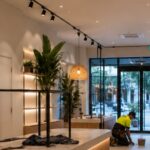
A jewellery store fitout occupies a category of retail design with no close parallel. The merchandise is high-value and small-format, creating security requirements that differ fundamentally from every other retail category. The customer journey depends on trust, desire, and a browsing environment where the customer feels welcome rather than watched.
Heavy-handed security design actively undermines that environment. The stores that perform best are those where the two priorities are never in tension, because the fitout team understood both from the start.

The core design challenge: Making security invisible
In a jewellery store fitout, security infrastructure and display design are not competing priorities: the fitouts that perform best in this category are those where security systems are embedded so completely into the physical environment that customers experience only the elegance.
Security-forward stores that rely on visible barriers, reinforced doors, and controlled entry can reduce conversion. Customers who feel surveilled or processed are not in the emotional state that leads to a luxury purchase. The stores that consistently perform best are those where security infrastructure is embedded fully into the design: the display cases are elegant, the lighting is warm, the sales team moves freely, and the security is comprehensive but invisible.
Colour plays a direct role in whether a jewellery store feels welcoming or clinical. The relationship between colour palette and customer behaviour in retail spaces is well documented and applies with particular force in jewellery retail, where the emotional context for purchasing decisions is shaped entirely by the environment.
Display case design
Case structure and materiality
Jewellery display cases in a premium fitout are structural elements, not off-the-shelf furniture. Custom-made cases allow the designer to specify glass thickness, locking mechanisms, lighting integration, and baffle designs that protect merchandise from smash-and-grab attempts while presenting product at its best.
Laminated glass rated for impact resistance is now standard in this category. Standard 6mm toughened glass delays a smash attempt rather than preventing it. Laminated glass of appropriate specification maintains structural integrity under impact, a change invisible to the customer but representing a significant uplift in physical security.
Case configuration and customer flow
Free-standing island cases create multiple approach angles, which increases browsing opportunity but also increases monitoring complexity. Wall-anchored cases reduce approach vectors and simplify staff positioning but create a more linear experience. The most effective configurations combine perimeter cases for high-value items with central island display for accessible ranges, allowing staff to position naturally between the most valuable merchandise and the store entry. This arrangement aligns security positioning with customer service positioning without any visible segregation.
Lighting design in a jewellery store fitout
Product illumination
Jewellery lighting is a specialised field. The colour rendering index (CRI) of the light source determines how gemstones appear and, consequently, how saleable they are. A CRI of 95 or above is best practice for diamonds and precious gemstones. Lower CRI values flatten brilliance and reduce the perceived quality of the merchandise. The principles of colour temperature and CRI selection are directly applicable to jewellery fitout, and retail lighting specification for high-end display environments covers the technical decisions that matter most.
Ambient and perimeter lighting
Ambient lighting should complement rather than compete with case lighting. The perimeter and ceiling fixtures set the mood. The case lighting is where the merchandise is featured. Maintaining a clear luminance hierarchy, where display cases are the brightest elements in the space, naturally draws customer attention and allows closed-circuit television (CCTV) systems to capture clear imagery without supplementary bright-spot fixtures that degrade the customer experience.
Security infrastructure integration
CCTV and access control
CCTV specification must cover all display cases, the entry point, any secure rooms or safes, and the sales counter. Camera positioning should be designed by a security consultant working in parallel with the fitout designer, not retrofitted after construction. Cameras mounted after construction is complete often have obstructed sight lines and cable runs that compromise the quality of finishes. Access control at the entry, whether a buzz-in system, controlled vestibule, or doorbell-and-camera entry, can be integrated into the shopfront design in a way that reads as service-oriented rather than defensive.
Safes and secure storage
Safes in a jewellery store are typically concealed within joinery. Purpose-built cabinetry can accommodate a safe without any visible indication that the storage exists. The structural requirements, including floor load capacity and anchor bolting, must be incorporated into the fitout drawings before construction begins. Adding a safe after handover requires cutting through completed finishes, which is expensive and results in visible patching.
Shopfront and entry design
The shopfront is both a marketing instrument and a security interface. A well-designed shopfront in a shopping centre or high-street location invites customers in while communicating brand positioning through materiality, lighting, and window merchandising. For high-street locations, security roller shutters are standard after hours. The design of these shutters and how they integrate with the shopfront is worth specifying carefully; a custom-perforated shutter in a brand-appropriate finish reads differently to a standard commercial roller, and the investment is visible to passing foot traffic at street level during closed hours.
The WELL Building Standard research framework covers how commercial environments affect human behaviour and wellbeing, including how light levels and spatial clarity affect the sense of safety in retail settings, findings directly applicable to jewellery retail design.
How the shopfront itself creates a first impression that drives entry rates is covered in depth in an analysis of shopfront designs that consistently stop customers, which is directly relevant for any jewellery operator planning a new site or refurbishment.
Budget planning for a luxury retail fitout
A premium jewellery store fitout in an Australian shopping centre or high-street location typically ranges from $3,500 to $6,000 per square metre, reflecting custom joinery, security glass, specialised lighting, and integrated security infrastructure. Smaller independent stores can achieve strong results at lower cost by prioritising case quality and lighting while using more economical treatments for floors and ceiling systems.
The investment logic is straightforward. Custom joinery and case quality communicate brand positioning at the first point of contact, and that first impression determines whether a customer enters and browses or keeps walking. A breakdown of the commercial return on a professionally specified fitout covers this case in detail, with particular relevance for high-average-transaction categories like jewellery.

Focus Shopfit has been delivering premium retail fitouts nationally since 1984. To talk through the design, security, and budget requirements of your jewellery store fitout with a team that understands both sides of the brief, get in touch with us.