

How to prepare a business for a commercial fitout with minimal downtime
A commercial fitout is one of the more significant operational events a business will go through. The construction period carries real risk to revenue, staff productivity, and customer relationships. Most of that risk is manageable when planning begins well before the first tradesperson arrives on site. This commercial fitout checklist provides a useful starting framework for mapping out what needs to happen before construction begins and what needs to be confirmed before trading resumes.
What follows is a practical preparation guide structured as two checklists: one for the weeks leading up to construction, and one for the period between practical completion and your doors reopening. Each item represents a decision or action that, if left unaddressed, typically surfaces as a more expensive and more disruptive problem during or after the build.

Before construction begins: Preparation checklist
Work through each of the following in the weeks leading up to your construction start date. The earlier each item is addressed, the more options you will have when something needs to change.
- Confirm your construction start and end dates in writing, and review the programme milestones in between. Make sure you understand which milestones represent genuine progress and which are buffer periods. The Australian Building Codes Board provides guidance on the approval and certification stages that make up a compliant fitout process, which is useful context when reading the programme your shopfitter provides. If any phase looks implausibly short, ask for an explanation before construction starts.
- Decide whether you will trade during construction, operate at a reduced capacity, or close fully for the duration. This decision shapes your staffing requirements, your customer communication plan, and your stock management strategy across the construction period. Reviewing common fitout mistakes to avoid before making this call highlights the planning oversights that most often cause disruption to businesses trading through a fitout.
- Communicate the fitout to your customers well in advance across all active channels, including in-store signage, email, and social media. Customers who feel informed are substantially more forgiving of temporary inconvenience than those who arrive unexpectedly to find access restricted or trading suspended. Framing the fitout as an investment in improving their experience goes a long way toward maintaining goodwill across the construction period and building anticipation for the reopening.
- Audit your stock and plan around the construction programme. If display fixtures or shelving are being replaced, establish where stock will be held during construction. Options include running down inventory deliberately in the weeks before the build starts, using off-site storage for the duration, or consolidating stock into a back-of-house area that will not be affected. For context on the scope of work involved and what is typically included in a shopfit of your type, the 2026 price guide for shop fitouts in Australia details how scope and cost vary across different fitout categories.
- Brief your staff early and establish a clear communication channel between your nominated project liaison and the fitout team's project manager. Staff who understand what is happening and when are better positioned to manage customer expectations throughout the construction period. They should know what areas are off-limits, what noise and disruption levels to expect on different days, and how to redirect customer enquiries about the new space.
- Review your lease and confirm what landlord approval requirements apply to the construction works. In shopping centres, all fitout work must be approved by centre management before any construction begins, and approved contractors must comply with the centre's construction management protocols. Your shopfitter should manage this approval process, but tracking its progress is the tenant's responsibility. Master Builders Australia provides guidance on tenant obligations and contractor responsibilities during commercial fitout works, which is useful background for any business owner going through this process for the first time.
- Arrange temporary facilities for staff if the fitout affects amenities including bathrooms, kitchen areas, or break rooms. If the premises will be fully closed during construction, confirm staff entitlements under the relevant enterprise agreement or award, and arrange for temporary redeployment to other locations where that is an option.
- For businesses in food and beverage, health, or any sector where hygiene standards and regulatory requirements apply to the trading environment, confirm with your fitout team how the construction zone will be physically separated from any areas that remain operational. Trading through a fitout in these environments requires careful planning and documented risk management. The ROI of a professional fitout covers why proper planning at this stage directly protects the financial outcome of the project.
Why the pre-build phase matters more than most businesses realise
Most fitout disruption is not caused by the construction itself but by decisions that were not made before construction started. The choice to trade through the build without a clear customer communication plan. The stock audit that was deferred and then became a crisis when shelving was removed ahead of schedule. The landlord approval that was assumed to be in progress but had never been formally submitted. Each of these is avoidable, and each is substantially easier to manage when it is identified as a decision point before the start date rather than as a problem during the build.
The preparation checklist above is designed to bring each of these decision points into view early enough to be managed properly. It is not exhaustive, but it covers the items that most commonly create problems for businesses during commercial fitout works.
Before the doors open again: Reopening checklist
Practical commercial completion is not the same as ready to trade. Practical completion means the construction is substantially finished and the premises can be occupied. It does not mean every defect has been resolved, every regulatory certificate has been received, or every system has been commissioned. Work through the following before opening to customers:
- Obtain all certificates of compliance from trades including electrical, plumbing, and gas, and file them with your lease documentation.
- Complete a formal defects walkthrough with the project manager and document every item requiring rectification, with agreed completion dates confirmed in writing before keys are accepted.
- Merchandise stock in the new layout with all staff briefed on changes to product placement, operational workflows, and any new systems or features in the space.
- Brief all staff on the new space before customers arrive, covering layout changes, updated service pathways, and how to use any new equipment or technology installed during the fitout.
- Arrange photographer access before opening to capture the new space for use across marketing channels, the website, and social media, while the space is clean and fully merchandised.
- Review the fitout process against the final outcome and document observations useful for planning future projects, including what worked well and what you would manage differently next time.

After opening: Post-fitout support
The weeks after opening are when minor issues surface that were not apparent during the handover walkthrough but become visible under trading conditions. Lighting that works differently with the floor full of people. A joinery door that requires adjustment once the air conditioning has cycled for a few weeks. Small defects that only appear once the space is in regular use. Focus Shopfit's maintenance service provides post-handover support covering warranty management, preventive maintenance, and reactive maintenance so that issues discovered after opening are resolved promptly without becoming operational headaches.
If you would like help structuring a fitout planning process that protects your business during construction, reach out to the Focus Shopfit team. Addressing these decisions before the start date is the most effective way to reduce disruption and protect the trading performance of your business throughout the project.


A guide to successful restaurant fitouts in Melbourne
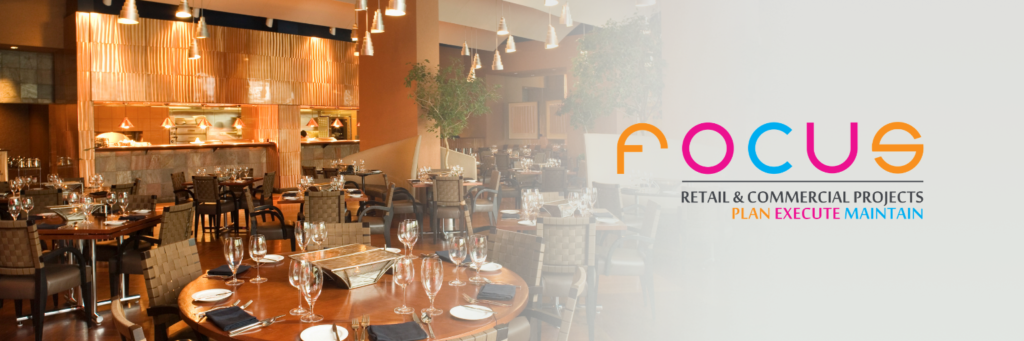
Melbourne's hospitality sector is one of the most competitive and design-conscious dining markets in Australia. Restaurant fitouts Melbourne operators commission need to achieve three things simultaneously: function as a compliant commercial kitchen capable of sustained high-volume service, create an atmosphere that customers return to, and hold up under the physical demands of daily trading across a five-to-ten-year tenancy. That is a more complex brief than it first appears, and most of the costly mistakes made in restaurant fitouts come from underestimating the weight of any one of those three requirements.
This guide covers what hospitality businesses should address when planning a restaurant or cafe fitout in Melbourne, from initial brief questions through to compliance, kitchen layout, front-of-house design, and the pre-opening checklist. For context on fitout investment, cost structure, and what affects the final price, the 2026 price guide for shop fitouts in Australia is a useful starting reference before engaging any contractor.
Starting with the right brief questions
A restaurant fitout brief needs to answer several specific operational questions before a drawing is produced. These questions shape every design decision that follows, and ambiguity at the brief stage is the most common reason fitouts require expensive variations during construction.
- What is the expected cover count at peak service, and what table configuration achieves it within the available floor plate while meeting egress requirements?
- Is the service model table service, counter service, or a combination, and how does that affect the relationship between the kitchen pass, service stations, and front-of-house circulation?
- What is the kitchen's maximum output in covers per service, and are the ventilation, gas, and electrical load provisions of the tenancy adequate for that volume?
- What ambience is the venue aiming for, and how do colour, materials, lighting, and acoustic treatment combine to create it? The psychology of colour in retail is a useful reference for understanding how colour choices affect customer behaviour and atmosphere in commercial hospitality environments.
- What is the anticipated trading life of the fitout, and which materials and finishes are specified to maintain their appearance under Melbourne's hospitality conditions across that period?
- What approvals does the project require, and what are the realistic timeframes for each? In Melbourne, planning permits, building permits, and food premises registration all have their own pathways and timeframes.
Commercial kitchen compliance in Victoria
The back-of-house is where compliance risk is highest in restaurant fitouts in Melbourne. The commercial kitchen must meet the requirements of Food Standards Australia New Zealand (FSANZ), the Food Act 1984 (Vic), and the standards enforced by the relevant council's environmental health officers. Failure to meet these requirements results in a failed food premises inspection, which prevents the venue from trading and requires rectification work before reinspection. Key compliance requirements for a Melbourne commercial kitchen include:
- Surface materials across walls, ceilings, and floors that are smooth, impervious, and cleanable to the standard required for food preparation areas under Australian Food Standards
- Separate handwashing facilities for kitchen staff at the kitchen entry, accessible without crossing food preparation areas, with warm running water and soap dispensing
- Refrigerated and dry storage with correct temperature control capabilities and physical separation of raw and ready-to-eat food items at every stage of the production flow
- Exhaust canopy specifications matched precisely to the cooking equipment load, with adequate make-up air supply to prevent negative pressure in the kitchen during service
- Grease trap sizing and installation location compliant with the relevant council's trade waste requirements, including accessible cleanout provisions
- Adequate lighting at all food preparation, storage, and cleaning areas to meet the minimum lux levels specified under food safety standards
Kitchen equipment selection and placement should be agreed with the chef before the fitout drawings are finalised, not after. The equipment layout determines the entire production flow, and changes to equipment placement after construction has begun are among the most expensive variations in hospitality fitout work.
Front of house: What creates atmosphere and drives return visits
In Melbourne's hospitality market, front-of-house design is examined by customers with high expectations and broad points of comparison. Three elements carry the most weight in determining whether a dining environment succeeds commercially.
Lighting
Warm, layered lighting distinguishes a memorable restaurant from a functional one. Task lighting for tables, ambient lighting for the room, and accent lighting for design features work together to create the atmosphere that converts a first visit into a regular. Tunable lighting systems that shift colour temperature across service periods, from bright daylight during lunch to warmer tones at dinner, are worth specifying. The complete guide to retail lighting solutions in Australia covers the specification principles that apply directly to hospitality design environments.
Acoustics
Hard surfaces, including polished concrete floors, exposed brick walls, and tiled finishes, are common in Melbourne's hospitality aesthetic but create challenging noise levels at full service capacity. The Acoustical Society of America has published research on how background noise levels in hospitality environments directly affect customer dwell time, conversation comfort, and satisfaction scores. Effective acoustic treatment in a restaurant fitout integrates architecturally, through ceiling baffles, upholstered booth seating, timber acoustic panels, and soft furnishings placed at intervals across the floor, rather than as an afterthought once the hard surfaces are already in place.
Joinery and material durability
Bar counters, host stations, booth seating, and display shelving all need to balance visual appeal with genuine durability under commercial trading conditions. Materials that photograph well but show wear within six months of opening undermine the venue's positioning in a market where customers share images and write detailed reviews. The specification standard should account for both the opening-day aesthetic and the two or three-year trading reality, because in Melbourne's hospitality market, a fitout that ages poorly is noticed.
Council approvals and permits in Melbourne
Restaurant fitouts in Melbourne almost always require both a planning permit and a building permit, particularly where a change of use is involved, structural alterations are proposed, or an alfresco dining area is being added. The permit process may also involve referral to Heritage Victoria where heritage overlays apply to the building or precinct. For a detailed comparison of how approval processes differ between Sydney and Melbourne, this guide to navigating council approvals covers the key differences. Starting the permit process early in the design phase, before construction documentation is complete, prevents weeks of unnecessary delay at the critical path.
Pre-opening checklist
Before trading begins, confirm all of the following are in order and documented:
- Food premises registration has been submitted to the relevant council environmental health team and a registration number has been received.
- Council inspection of the kitchen has been scheduled and passed, including compliance with FSANZ requirements and the Food Act 1984 (Vic).
- Electrical, plumbing, and gas certificates of compliance have been obtained from all licensed trades and filed with the lease documentation.
- Exhaust canopy performance has been tested under full cooking load and make-up air has been confirmed as adequate before service begins.
- An accessibility review confirms DDA-compliant entry, accessible amenities, and appropriate signage throughout, in line with Australian Human Rights Commission requirements for public premises.
- All outstanding defects from the practical completion inspection have been rectified and signed off before the first service.

Focus Shopfit brings experience across retail and hospitality commercial fitouts Melbourne to every project. To talk through your restaurant or cafe fitout with a team that understands both the compliance requirements and the design ambitions of the Melbourne market, get in touch here and start the conversation.
A guide to the design and compliance of pharmacy fitouts
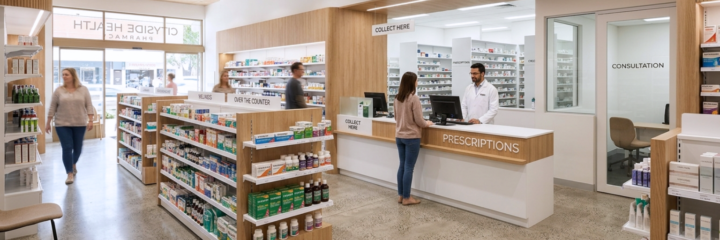
Pharmacy fitouts occupy a category of their own within commercial fitout work. They combine a strictly regulated dispensary environment with a retail consumer-facing space, and the design must serve both functions with equal care. A patient walking in wants a space that feels professional, calm, and easy to navigate. The dispensary team needs a layout that supports accuracy, efficiency, and full compliance with the legal requirements governing how controlled substances are stored and dispensed.
The challenge is that these two requirements pull in slightly different directions. Retail spaces benefit from openness, browsing-friendly layouts, and prominent product displays. Dispensary environments require controlled access, defined workflows, and secure storage. A well-designed pharmacy fitout resolves this tension rather than compromising either side of it. This guide covers the core elements of designing and delivering pharmacy fitouts in Australia, from the regulatory foundations through to retail pharmacy design, joinery specification, and pre-handover compliance. For an example of how these principles apply in practice, this look inside a high-end medical fitout in Perth illustrates the standard of finish and compliance detail that a capable fitout team delivers.

What the regulatory framework requires
Australian pharmacies are regulated at the state and territory level, but all operate under the professional standards set by the Pharmacy Board of Australia. Before any design work begins, the following requirements need to be incorporated into the fitout brief and confirmed with the client's pharmacist-in-charge and any relevant regulatory body:
- Physical separation of the dispensary from the retail floor, with access controlled to authorised staff. The configuration of this separation varies by state but must in all cases prevent customer access to dispensary areas.
- Secure storage for Schedule 8 controlled substances, complying with state regulations on safe specifications, security ratings, and installation requirements. Requirements vary between states and must be confirmed against the relevant legislation before specification.
- A private consultation area for patient counselling, soundproofed adequately for conversational privacy and accessible for patients with mobility impairments, including compliant door width and unobstructed floor space.
- DDA compliance across the premises: accessible aisles, a compliant service counter with a lowered section, and an accessible entry. The Australian Human Rights Commission sets out what DDA compliance requires for premises open to the public, and these requirements need to be confirmed against the specific building class and occupancy type during the design phase.
- State-specific premises requirements. In Western Australia, for example, the Pharmacy Act 2010 sets out conditions that must be met for a licence application or renewal, including specific provisions around the arrangement of dispensary areas and patient consultation facilities. Other states have equivalent frameworks that must be confirmed with the relevant pharmacy authority before the design is finalised.
- Adequate hand hygiene facilities for dispensary staff and, where clinical services are provided, in the consultation area. The location, specification, and number of hand hygiene stations may be subject to specific requirements under state health legislation.
Identifying these requirements at the design stage avoids the cost and disruption of redesigning elements after documentation has been prepared or construction has begun. The most expensive changes in any fitout are those required after documentation is locked or construction has started.
Dispensary layout and staff workflow
The dispensary is the operational core of any pharmacy. Its layout directly affects script throughput, dispensing accuracy, and staff fatigue levels across a full trading day. Poor ergonomic design in dispensary environments is a documented contributor to workplace injury, particularly musculoskeletal disorders affecting the wrists, shoulders, and lower back. Safe Work Australia identifies workstation design as one of the most effective controls for reducing musculoskeletal disorders in high-repetition work environments. An effective dispensary layout accounts for all of the following:
- A logical production flow from script receipt through dispensing, clinical check, and patient handover at the dispensary counter, with no crossing of pathways between clean and used medication handling areas
- Adequate bench space for labelling, packaging, and clinical verification, with ergonomic counter heights throughout the dispensary to reduce cumulative fatigue over a full shift
- Integration provisions for dispensing robots or automated dispensing units (ADUs) where relevant, including appropriate floor loading, power supply, data connection, and ventilation provisions sized for the specific unit being installed
- Clear separation of fast-moving and slow-moving medication storage, with the most frequently accessed products positioned for minimum reach and movement
- Clear sightlines from the dispensary to the retail floor and the front counter, allowing supervision of the retail area and visual queue management from the dispensing workstation
Retail pharmacy design: The customer-facing environment
The retail component is where brand identity, product range, and patient experience intersect. Retail pharmacy design involves considerably more than arranging shelving categories. It shapes how patients perceive the quality of care they receive and directly influences purchase behaviour across health, wellness, and OTC product categories. Key design decisions in the retail zone include:
- Category zoning that creates a logical patient journey from front-of-store impulse categories through to health and wellness zones positioned closer to the dispensary counter
- Gondola heights and shelving depths that balance product visibility and range presentation with accessibility for elderly patients and those with reduced reach or mobility
- Lighting design that supports clear product legibility, creates a professional and reassuring atmosphere, and minimises glare in consultation and waiting areas. The complete guide to retail lighting solutions in Australia covers the specification principles that apply directly to pharmacy retail environments.
- Colour and material choices that communicate trust, calm, and clinical professionalism. The psychology of colour in retail is particularly relevant in health environments where patient confidence is a central part of the brand proposition.
Joinery specification for pharmacy fitouts
Pharmacy joinery must meet durability, hygiene, and operational requirements simultaneously, which creates a more demanding specification brief than most retail fitout categories. Dispensing benches need to be specified for the cleaning agents and disinfection protocols used in the dispensary environment. Retail fixtures need to withstand daily restocking and customer browsing without showing premature wear. Consultation room joinery needs to balance privacy screening with a welcoming, non-clinical feel.
Where dispensing software hardware is integrated into benchtop design, the joinery specification requires input from the dispensing system provider to confirm correct placement, cable access, ergonomic height, and screen positioning. This coordination needs to happen during the design phase, not during installation.
Pre-handover compliance checklist
Before a pharmacy fitout is handed over and a premises licence application is submitted to the relevant state authority, confirm the following items have been addressed and documented:
- S8 controlled drug safe installed, compliant with the applicable state drug regulations, and a compliance certificate obtained
- Consultation room privacy, soundproofing, and DDA access provisions verified against applicable standards and confirmed with the pharmacist-in-charge
- DDA-compliant service counter with lowered section confirmed, accessible entry pathway confirmed clear and measured
- Dispensary access control limiting entry to authorised staff operational and confirmed with the responsible pharmacist
- Commercial fitout accessibility requirements confirmed against the NCC accessibility provisions for the relevant building class and occupancy
- Certificates of compliance from electrical, plumbing, and other licensed trades obtained, filed, and available for submission with the licence application

Pharmacy fitouts require a team familiar with both regulated commercial environments and quality construction delivery. If you are planning a new pharmacy fitout or a refurbishment of existing premises, speak with the Focus Shopfit team to discuss how the design and compliance requirements can be managed efficiently from brief through to handover.
What is the average shop fitout timeline in Australia?
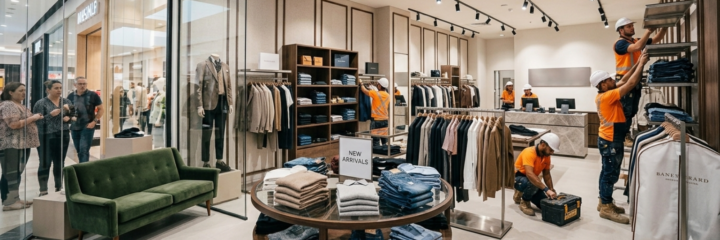
Understanding a shop fitout timeline before committing to a lease or setting a trading start date can prevent significant stress and financial exposure. Business owners regularly underestimate how long a fitout takes, particularly when council approvals, custom manufacturing, and trades coordination are factored in alongside the physical construction work.
This guide walks through the main phases of the commercial fitout process in Australia and provides realistic timeframes based on project type and scope. The phases below are broadly sequential, though experienced fitout teams run procurement in parallel with approvals to compress the overall programme. For a consolidated view of the full process, this commercial fitout checklist is a useful companion reference.
Phase 1: Brief, concept, and design – 2 to 6 weeks
Every fitout begins with a brief. This covers operational requirements, customer experience goals, brand identity, any technical constraints of the tenancy, and the commercial parameters within which the design must be delivered. From the brief, a concept design is developed and refined through rounds of feedback. A straightforward retail shopfit may move through this phase in two to three weeks. A more complex project involving multiple departments, specialist fitout categories, or a new brand identity can extend this phase to six weeks or beyond.
Getting this phase right is what allows everything downstream to run without costly rework. Changes made on paper cost almost nothing. Changes made during construction cost considerably more. The Australian Institute of Architects provides guidance on what thorough design documentation involves, which gives useful context when evaluating the quality of a shopfitter's design process before any documents are signed.
Phase 2: Documentation and approval – 4 to 10 weeks
Once the design is agreed, construction documentation is prepared: architectural drawings, engineering specifications, joinery drawings, and a formal scope of works. Depending on the nature of the work, the tenancy may require council development approval (DA) or a complying development certificate (CDC), or the works may only need landlord and building management sign-off. The Australian Building Codes Board (ABCB) provides guidance on the building approval framework across Australian jurisdictions, which is useful background for anyone navigating this process for the first time.
In shopping centres, landlord approval involves a design audit against the centre's fitout guidelines, which can include requirements around materials, signage size, lighting colour temperature, and service access provisions. This process can take three to six weeks depending on the centre management team's workload and how well the submitted documentation meets their standard requirements. This phase is where the most unpredictable delays occur in the overall programme, which is why engaging a shopfitter familiar with the relevant approval process makes a meaningful difference to the total timeline.
Phase 3: Procurement and manufacturing – 3 to 8 weeks
Custom joinery typically takes four to eight weeks to manufacture, depending on design complexity, finish selection, and the manufacturer's current capacity. The commercial fitout process runs more efficiently when procurement begins as soon as the design is locked and before formal approvals are fully resolved, provided the design is unlikely to change materially during the approval process.
Running procurement in parallel with approvals is standard practice for experienced fitout teams and is the single most effective way to compress the overall programme without cutting corners. For broader context on what the full scope of a shopfit includes and where the cost sits across different project types, the 2026 price guide for shop fitouts in Australia covers the variables in detail.
Phase 4: On-site construction – 2 to 8 weeks
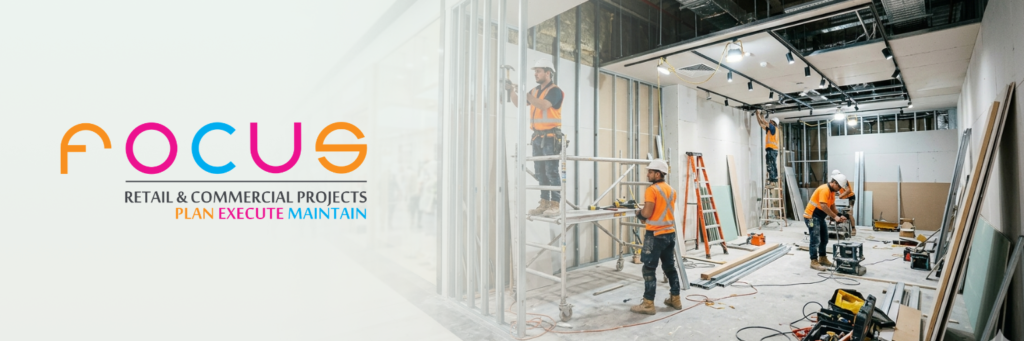
The physical construction phase covers demolition and strip-out where required, rough-in trades including electrical, plumbing, and data, framing and lining, ceiling installation, joinery installation and fitting, floor finishes, painting and decoration, and final fixtures. The duration of this phase varies considerably by project type and tenancy condition.
A basic refresh of an existing retail space with minimal structural change may take two to three weeks on site. A full strip-out and new fitout for a 200 square metre retail tenancy typically takes five to eight weeks. Hospitality and medical environments with complex mechanical services, exhaust systems, or specialised compliance requirements generally sit at the upper end of the range or beyond it. The key variable is the number of trades working on site and how well their sequencing has been planned in advance.
Phase 5: Commissioning and defects – 1 to 2 weeks
Once construction is substantially complete, a commissioning period covers testing of electrical and mechanical systems, review of all finishes and joinery against the approved specification, checking of signage and fixtures, and a formal defects inspection with the client. Reviewing common mistakes to avoid during a retail fitout is useful preparation for this stage to ensure nothing has been overlooked before keys are handed over. Rushing to open without completing a proper defects inspection creates risk around safety compliance, warranty coverage, and the quality guarantee.
Summary of typical total timeframes
- Straightforward retail shopfit in an existing tenancy with landlord approval only, no council DA required: 8 to 14 weeks from brief sign-off to opening
- Full commercial fitout in a new tenancy requiring council DA or shopping centre approval process: 16 to 24 weeks from brief sign-off to opening
- Hospitality, pharmacy, or medical fitouts with complex services requirements: typically at the upper end of that range, sometimes extending beyond 24 weeks depending on the approval pathway

What causes delays and how to manage them
The most common causes of fitout delay in Australian commercial projects are incomplete design documentation that leads to variations on site, approvals that take longer than anticipated because of insufficient documentation or late submissions, materials ordered without confirmed lead times creating gaps in the construction programme, and insufficient trades coordination leading to sequencing conflicts and rework. Each of these causes is substantially mitigated by engaging a shopfitter with strong project management capability before the brief is finalised.
Focus Shopfit's execution service addresses these variables through dedicated project management from the approval phase through to installation and commissioning. You can review how that process is structured before your project begins to understand how each phase is managed and where accountability sits.
If you are ready to map out a realistic shop fitout timeline for your project, contact Focus Shopfit to start the conversation with a team that has managed Australian fitout projects across retail, commercial, hospitality, and medical sectors since 1984.
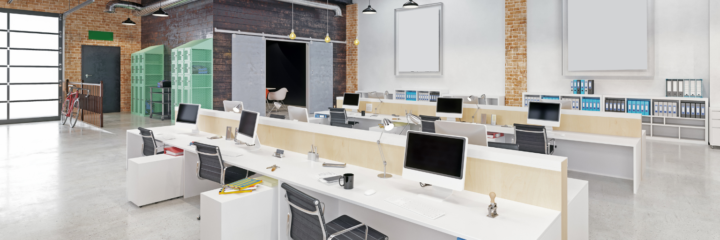
What are the key elements of modern office fitouts in Perth?
The expectations placed on modern workplaces have shifted considerably. Hybrid working patterns, staff wellbeing, brand culture, and technology infrastructure have all become design requirements that office fitouts in Perth must address. Perth businesses investing in commercial office space today expect their fitout to actively support the way their teams work, not simply provide a fixed number of desks in a floor plan.
This guide covers the key elements that define a high-performing modern office fitout across design, acoustics, technology, compliance, and long-term flexibility. Each element is worth considering independently, but they deliver the best outcomes when planned together from the earliest stages of the brief.
Zoning and spatial variety
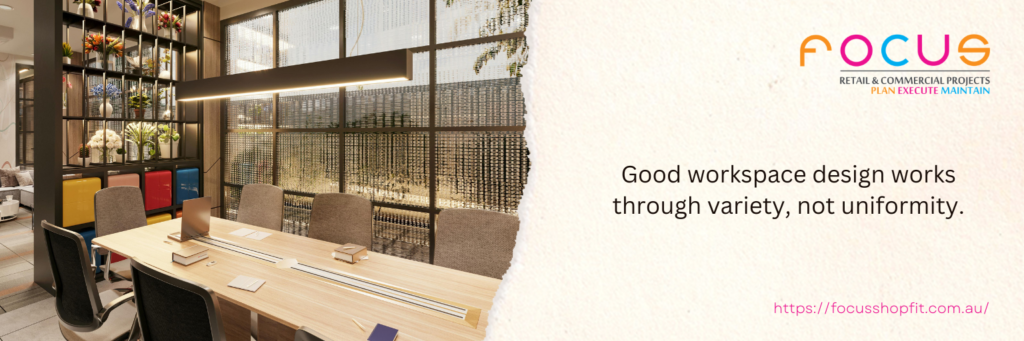
Good workspace design works through variety, not uniformity. A well-zoned office gives people genuine choices about how and where they work throughout the day, which has a measurable effect on output and satisfaction. The WELL Building Standard, which benchmarks commercial environments against health and productivity criteria, identifies spatial variety as a core factor in staff performance. A functional office fitout should include at least four distinct zone types:
- Focus zones: quiet areas for concentrated individual work, either fully enclosed or semi-enclosed to reduce acoustic intrusion from the surrounding floor
- Collaboration zones: open or semi-open areas configured for team discussion, ideation, whiteboard sessions, or informal stand-up meetings
- Breakout and social spaces: areas with a clearly different atmosphere from the primary work floor, giving staff a genuine mental transition away from desk-based work during breaks
- Formal meeting rooms: enclosed, bookable, and equipped with appropriate AV infrastructure for internal planning and external client meetings
Even in compact tenancies, clear spatial zoning creates a sense of variety and supports the range of working styles present across any team. The key is ensuring each zone is genuinely differentiated in its acoustic properties, its furniture configuration, and its visual character, rather than simply labelled differently on a floor plan.
Acoustic management
Open-plan offices are frequently cited by staff as the primary source of dissatisfaction with their working environment, and noise is consistently the leading complaint. Perth commercial builders working on office fitouts need to treat acoustics as a design requirement from the outset, not a retrofit problem to be solved after occupancy. Research from the Acoustical Society of America consistently identifies unwanted speech as the leading environmental complaint in open workplaces, with measurable negative effects on concentration and task accuracy. Effective acoustic management in an office fitout typically includes:
- Ceiling baffles and suspended acoustic panels that reduce reverberation across the floor plate, particularly important in tenancies with exposed concrete ceilings or polished floors
- Soft furnishings, including upholstered seating, area rugs, and fabric-faced partitions that absorb mid-frequency noise in breakout and collaboration areas
- Glazed or acoustic-rated partitions around focus zones and phone rooms, containing noise without fully enclosing the space and maintaining visual connection across the floor. The retail lighting and sensory design guide covers related principles for managing the full sensory environment in commercial fitouts, which apply equally in office settings.
- Strategic placement of high-traffic areas, including kitchen and breakout facilities, printer stations, and informal social zones away from focus work areas and close-concentration zones
- Sound masking systems in larger open-plan floors, which raise the ambient noise floor to a consistent level and reduce the intelligibility of distant conversations without making the environment feel louder
Lighting for productivity and wellbeing
Perth's climate gives most commercial tenancies access to strong natural light for much of the year. Managing glare and solar heat gain while maintaining the connection to daylight requires deliberate specification choices. A layered approach to office lighting produces the best outcomes:
- Task lighting at workstations, individually adjustable to suit different working styles and the changing ambient conditions throughout the day
- Ambient lighting creates a consistent background level across the floor without harsh glare or shadow at desk level. For a broader context on commercial lighting specification, this guide to retail lighting solutions in Australia covers the principles that translate directly into office environments.
- Tunable LED systems that shift colour temperature across the day, supporting circadian health by providing cooler, more energising light in the morning and warmer, lower-intensity light in the afternoon
- Localised lighting in meeting rooms and collaboration zones on dimmable circuits, adjustable to suit the type of activity taking place from focused review sessions to informal social interactions
Technology and data infrastructure
Technology infrastructure for office fitouts in Perth must be planned from the earliest design stage. Adding infrastructure after construction is completed is consistently more expensive and more disruptive than building it in from the start. Key infrastructure decisions that need to be resolved before construction begins include:
- Structured cabling with adequate data points distributed across the floor plate, including at collaborative zones and informal work areas, not only at fixed desk positions
- Wireless access point placement agreed with the client's IT team during the design phase, with conduit and cable pathways coordinated in the ceiling before any finishes are applied
- AV infrastructure in meeting rooms: screens, ceiling microphone arrays, and appropriate cable management for reliable hybrid conferencing across multiple time zones
- Power and USB access at breakout seating and collaboration tables, where flexibility of connection is increasingly expected as a baseline, not a premium feature
- Server and communications room provisions where required, including adequate ventilation, secure access, and appropriate power supply with backup provisions
Joinery, finishes, and brand expression
The visual quality of an office fitout communicates brand values to staff and visitors from the moment they enter. Custom joinery, including reception desks, storage systems, and breakout cabinetry, is where quality is most immediately visible and where the difference between a considered fitout and a generic one is most apparent. The role of custom joinery in Perth commercial fitouts covers how material selection and joinery specification shape the finished result. The key considerations when specifying joinery for an office fitout are durability matched to actual use patterns, brand integration that feels considered rather than applied as decoration, and lead times that are accounted for in the construction programme. Custom joinery typically takes four to eight weeks to manufacture, which is one reason why early engagement with the fitout team produces direct benefits in programme management.
Compliance and future-proofing
Office fitouts Perth must meet the National Construction Code (NCC) and relevant Australian Standards, including Disability Discrimination Act provisions for accessible pathways, compliant service counter heights, and egress requirements. A fitout team familiar with the local approval process will incorporate these requirements during the design phase, where they are straightforward to address, rather than under a compliance notice after occupancy, where they become expensive and disruptive to rectify.
A fitout designed only for current conditions will cost more to adapt than one built with flexibility from the outset. Features that improve the longevity of an office investment include demountable partitioning systems, modular furniture with reconfiguration options, and accessible cabling infrastructure that can be extended or rerouted without major construction. This is particularly relevant for businesses in growth phases, where team size and structure may shift significantly within the first three years of a lease term.
Focus Shopfit's planning service covers design, joinery manufacture, and value engineering across office fitout projects throughout Perth and the broader Western Australian market. To discuss your office fitout with a team that understands workspace design and local compliance requirements, start the conversation here.
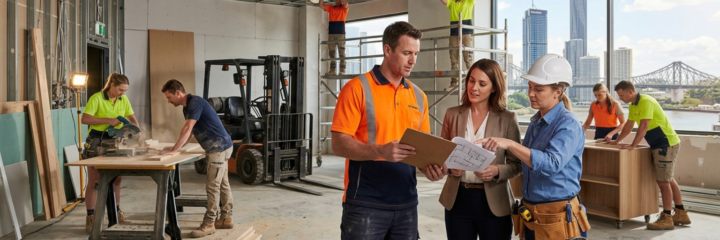
Key considerations for businesses hiring shopfitters in Brisbane
Brisbane's commercial fitout market has grown considerably over the past few years, and so has the range of operators calling themselves shopfitters. That expansion makes the selection process more important than ever. Choosing the wrong team leads to budget overruns, missed deadlines, and compliance problems that take months to untangle. Choosing the right one means engaging a team with proven experience in commercial fitouts Brisbane businesses can count on to deliver on time, on budget, and to the required standard.
The eight questions below give business owners a structured way to assess any shopfitter before committing to a contract. They are not designed to be exhaustive, but to surface the issues that most commonly determine whether a fitout succeeds or becomes a drawn-out problem.
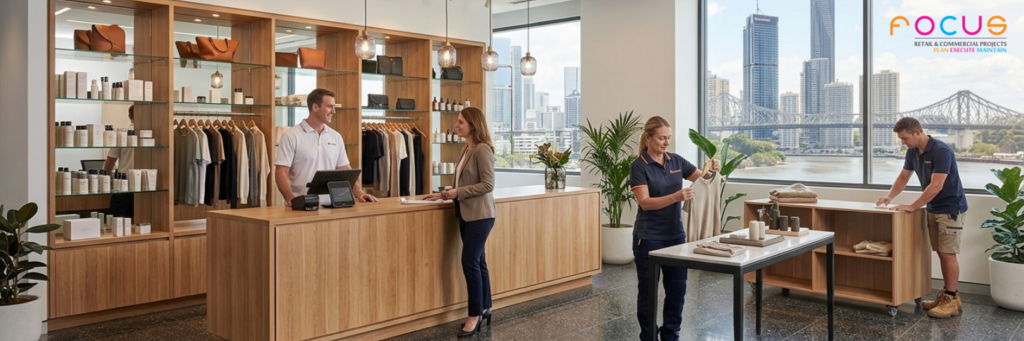
- Do they have direct experience with Brisbane City Council requirements? Local knowledge changes outcomes. Queensland's DA pathways, shopping centre landlord approval processes, and building codes have their own nuances that take time to learn. A shopfitter with extensive Brisbane experience will already be familiar with the documentation requirements that hold up less experienced operators, the council referral processes that add weeks to approvals, and the standard conditions that appear in typical DA consent for commercial tenancies. The Queensland Building and Construction Commission (QBCC) maintains a licence register where you can verify a contractor's credentials before committing to any agreement.
- Who manages the project on site, and what is their background? Ask directly about the project manager assigned to your job. Project managers with trades backgrounds understand site sequencing at a level that those without hands-on experience often do not. When multiple trades need to be carefully coordinated to avoid rework, that background matters considerably. For a sense of how trades coordination shapes delivery across a full commercial fitout, this commercial fitout checklist is worth reviewing before your initial meetings with any prospective shopfitter.
- Can they provide a fixed-price contract? The gap between a quoted price and a final invoice is one of the most common sources of conflict in fitout projects. Understand what is fixed and what is subject to variation before you sign anything. PC (prime cost) items and provisional sums are legitimate budget tools, but they should be clearly identified and estimated conservatively, not used to keep the headline figure artificially low while leaving significant exposure in the detail. Ask to see a breakdown that identifies each variable item and its basis for estimation.
- What does their construction programme look like, and how detailed is it? Ask for a programme that breaks down each phase: design, approvals, procurement, manufacture, and on-site construction. Check whether lead times for custom joinery and materials are factored in. A realistic programme reflects an experienced team that has delivered comparable projects before. The Australian Institute of Architects provides guidance on what a thorough design and documentation phase involves, which gives useful context when evaluating the realism of what your shopfitter is proposing. A programme that shows every phase completed within an implausibly short timeframe is a warning sign, not a selling point.
- Are their licences and insurance current? In Queensland, anyone performing structural, electrical, or plumbing work as part of a fitout must hold the appropriate contractor's licence under the QBCC framework. Ask for a copy of the relevant licences before work begins. Public liability insurance and contract works insurance certificates should also be current, adequate in coverage, and provided as a condition of engagement. Checking these documents takes minutes and protects your business considerably if something goes wrong on site. For context on what fitout costs include and what drives price variation, the 2026 price guide covers the key variables across different fitout types.
- Can they demonstrate design and value engineering capability? A capable fitout team should be able to work from your brief, propose alternatives where the design exceeds budget, and use material and construction knowledge to find solutions that deliver the right outcome at the right cost. That capability separates an experienced team from one that simply builds what it is told and raises variations whenever the scope goes beyond a narrow interpretation of the brief. Reviewing common mistakes to avoid during a retail fitout helps frame the right questions to ask about how your prospective shopfitter handles the design process and manages scope discussions before construction begins.
- Do they have references from comparable projects? Ask for clients whose projects were similar in size, sector, or tenancy type to yours. A portfolio shows finish quality, while references reveal how the business operates under pressure. Ask specifically about how unforeseen issues were handled once work was underway, how variations were communicated and agreed, and whether the project manager was accessible and responsive throughout the job. A shopfitter with nothing to hide will be comfortable making their past clients available for a brief conversation before you commit.
- What does their post-handover support look like? Understanding the defects liability period, what it covers, how warranty claims are managed, and how quickly rectification work is scheduled, is as important as understanding the construction phase itself. Defects found in the first months of trading are common in any fitout. The quality of the shopfitter's response to those defects is a reliable indicator of how they value long-term client relationships. Master Builders Australia publishes guidance on what to expect from a licensed contractor during the defects liability period, which is useful reading before you finalise any fitout contract.
Why the selection process matters more than price
Many businesses begin their search for shopfitters in Brisbane by comparing quotes. Price is a relevant factor, but it is a poor primary filter. A low quote that results in a fitout delivered six weeks late, with compliance issues outstanding and finishes below the standard specified, is more expensive than a higher quote from a team that delivers what was agreed. The cost of disrupted trading, the cost of rectification work, and the reputational impact of opening in a space that does not meet expectations can all accumulate quickly.
The questions above are designed to shift the evaluation framework from price to demonstrated capability. A team that answers them clearly, with reference to specific past projects and verifiable credentials, is showing competence and transparency at the same time. A team that deflects, generalises, or cannot name comparable commercial fitouts for Brisbane businesses they have delivered should be considered carefully before any commitment is made.
One practical approach is to submit the same written brief to three or four prospective shopfitters and compare not just the quoted price but the quality of the response. How a shopfitter interprets a brief, what clarifying questions they ask, and how they structure their programme and cost breakdown all reveal how they will behave once the job is underway. The evaluation process itself is a reliable preview of the working relationship.

Making the right choice
Selecting shopfitters in Brisbane is a business decision as much as a construction one. The businesses that get the best outcomes ask thorough questions early, verify what they are told, and engage a team with a documented track record. Focus Shopfit has been managing commercial and retail fitout projects across Australia since 1984. The team's structure is built around accountability at every stage, from initial design brief through to post-handover maintenance, with a single point of contact throughout.
To start a conversation about your Brisbane fitout, contact the Focus Shopfit team and get a clear picture of what your project involves before any commitments are made.
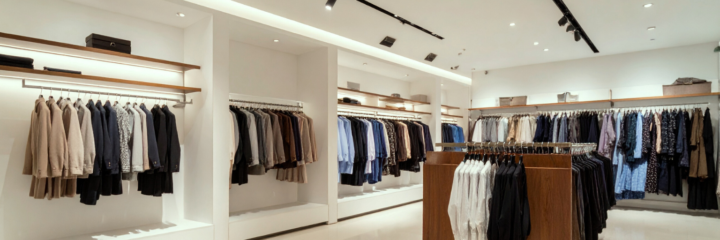
Retail store layout ideas for Australia: Open-plan vs. zoned
The layout of your retail store in Australia is one of the most influential elements of your commercial fitout. It is the silent architect of the customer experience, dictating how shoppers move through your space, what they see, and how they interact with your products. The right shop layout guides your customer on a journey and does not just present them with products. When considering retail store layout ideas, two dominant philosophies emerge: the open-plan layout and the zoned layout.
Each approach has distinct advantages and disadvantages, and the right choice depends entirely on your brand identity, your product type, the size of your space, and the specific customer journey you want to create. Understanding the fundamental differences between these two styles is the first step in making a strategic decision that will directly impact your sales and brand perception.

What an open-plan layout does well
An open-plan shop layout is characterised by its lack of interior walls and major obstructions. It prioritises clear sightlines from the front of the store to the back, creating a feeling of spaciousness and freedom. This layout typically uses freestanding fixtures, low-profile shelving, and strategically placed tables to define areas without physically enclosing them.
Advantages of open-plan layouts
- Perceived space: The most immediate benefit is that it makes a small space feel significantly larger and more inviting.
- Flexibility: An open plan is highly adaptable. Fixtures can be easily rearranged to accommodate new stock, seasonal promotions, or even in-store events. This modular approach is a key benefit explored in modular shopfitting.
- Encourages exploration: With everything visible, customers are encouraged to wander and browse freely, which can lead to the discovery of products they were not initially looking for.
- Excellent visibility: Staff can easily monitor the entire sales floor, improving both customer service and security.
Where open-plan layouts struggle
- Can feel overwhelming: A lack of defined paths can sometimes feel chaotic or directionless to a customer who is looking for a specific item.
- Lack of intimacy: It can be difficult to create quiet, intimate corners for high-consideration purchases.
- Noise and acoustics: Sound travels easily in an open space, which can create a noisy and less relaxing environment. Practical ways to manage this are covered in our blog on acoustic design.
- Best suited for: Clothing boutiques, modern technology stores like Apple, department stores, and retailers who want to create a high-energy, communal atmosphere. The team at Focus Shopfit often implements open-plan designs for fashion clients like Gazman.
What a zoned layout does well
A zoned layout, also known as a boutique layout, deliberately uses walls, partitions, different flooring materials, or changes in ceiling height to divide the retail space into distinct, curated sections or zones. Each zone can have its own specific purpose, atmosphere, and product focus, creating a series of discovery moments for the customer.
Advantages of zoned layouts
- Guided customer journey: This layout gives the retailer maximum control over how a customer moves through the store, allowing for strategic product placement and storytelling.
- Creates intimacy and focus: Zoned areas can create a more intimate and focused shopping experience, which is ideal for luxury goods or products that require detailed consideration.
- Defines product categories: It provides a clear and intuitive way to separate different departments, such as men's, women's, and children's clothing, or different types of homewares.
- Atmospheric control: Each zone can have its own unique lighting, music, and decor, creating different moods within a single store.
Where zoned layouts struggle
- Can feel smaller: The use of walls and partitions can make the overall space feel less expansive.
- Less flexible: It is more difficult and expensive to reconfigure a zoned layout to accommodate changes in merchandising strategy.
- Potential for bottlenecks: Poorly designed transitions between zones can create pinch points and disrupt customer flow.
- Best suited for: Bookstores, large speciality food stores, homewares stores with distinct departments, and luxury brands that want to create an exclusive, gallery-like feel.
A hybrid approach
The decision between these retail store layout ideas is not always binary. Many of the most successful retail spaces, like those showcased in industry publications such as Inside Retail, use a hybrid approach. They might use an open-plan concept for the main floor while creating distinct, zoned areas for featured collections or high-end items. The best choice comes from answering a few key questions:
- What is your brand identity? Are you open and energetic, or curated and sophisticated?
- What are you selling? Do customers need space to browse freely, or do they need focused areas for consideration?
- Who is your customer? Are they on a quick mission or enjoying a leisurely browse?

Unsure which layout is right for your brand? The design experts at Focus Shopfit can analyse your space, brand, and business goals to develop a shop layout that optimises customer flow and maximises sales. Real-world examples of retail store layout ideas can be seen in project highlights, and you can schedule a discovery call with our design team today by visiting our contact page.

The benefits of professional retail fitout project management
Why fitout project management matters
A commercial fitout is a complex and high-stakes undertaking. It involves coordinating dozens of moving parts, from designers and suppliers to a multitude of specialised trades, all while navigating strict timelines, budgets, and regulatory requirements. For a business owner, attempting to manage this intricate shopfitting process while also running their business can be overwhelming and lead to costly mistakes. This is where professional retail fitout project management becomes one of the most valuable investments you can make.
While some may view hiring a project manager as an additional expense, experienced retailers understand the truth: a great project manager does not cost you money; they save you money, time, and stress. Unlike general commercial builders, a specialist shopfitting project manager brings industry-specific expertise that ensures your project is delivered to the highest standard, on schedule, and on budget.
Let's break down the tangible benefits they bring to the table.

Cost control and scope clarity
One of the biggest fears in any construction project is a budget blowout. A professional project manager (PM) is your first line of defence against unexpected costs.
- Accurate quoting and trade tendering: Experienced PMs have established relationships with a network of reliable and competitively priced tradespeople. They can obtain multiple, detailed quotes and ensure there are no hidden costs.
- Scope management: The PM ensures that the project sticks to the agreed-upon scope of works, preventing scope creep where small, unbudgeted additions slowly inflate the total cost.
- Value engineering: A skilled PM can often suggest alternative materials or construction methods that achieve the same aesthetic and functional goals for a lower cost, without compromising on quality. This financial oversight is a core function of professional retail fitout project management.
Timeline protection and trade coordination
In retail, time is money. Every day your store is closed for a fitout is a day of lost revenue. A project manager's primary responsibility is to ensure the project is completed as quickly and efficiently as possible.
- Master scheduling: The PM creates a detailed master schedule, often using tools like Gantt charts, that maps out every single task. More importantly, they understand the sequence of critical tasks that determine the project's total duration.
- Trade coordination: A fitout requires a precise sequence of trades. The electrician cannot wire the walls after the plasterer has finished. The PM orchestrates this complex dance, ensuring each trade is on site at exactly the right time, preventing costly downtime and delays. A clearer view of this coordination is outlined in the essential guide to consulting with shopfitters.
Quality control on site
A project manager acts as your expert eyes and ears on site. They are solely focused on ensuring the quality of the workmanship meets the highest standards and matches the design specifications.
- On-site supervision: PMs conduct regular site inspections to oversee the work of all trades, catching potential issues before they become major problems.
- Material verification: They ensure that the materials being used on site are the exact ones specified in the design documents, preventing substitutions with lower-quality alternatives. Many professional bodies, like the Australian Institute of Project Management (AIPM), provide certification that attests to a PM's expertise in this area.
Compliance and safety
Commercial fitouts are governed by a web of regulations, from building codes to workplace health and safety (WHS) standards. A PM navigates this complex landscape on your behalf.
- Permits and approvals: They manage the entire process of lodging plans and obtaining the necessary permits from local councils and building certifiers.
- WHS compliance: The PM is responsible for ensuring the work site is safe and compliant with all workplace health and safety (WHS) requirements, protecting you from potential liability. Experienced commercial builders and project managers make this a top priority.
Less stress, clearer communication
Perhaps the most underrated benefit of retail fitout project management is the peace of mind it provides. Instead of juggling calls from a dozen different tradespeople, you have one single, accountable point of contact. The PM provides you with regular, consolidated updates and handles all the day-to-day problem-solving, freeing you up to focus on what you do best: planning for the launch of your new store.
Focus Shopfit integrates this level of professional management into every project, ensuring a seamless client experience. A practical view of what build coordination and handover typically includes is outlined here: build and handover approach.

An investment in professional project management is an investment in certainty. It provides certainty on cost, timeline, and quality, turning a potentially chaotic process into a structured and predictable journey. Ready for a seamless and stress-free fitout? Focus Shopfit's dedicated project management team is ready to take the lead on your next project. to learn more about our process.

5 shopfront designs that will stop customers in their tracks
Why shopfront design matters
In the bustling world of physical retail, the battle for customer attention begins on the footpath. Before a customer can experience your product, your service, or your brand's atmosphere, they must first be compelled to walk through your door. Your shopfront is the single most important piece of marketing real estate you own. It is your first handshake, your 24/7 advertisement, and the cover of your brand's storybook. A strategic and compelling shopfront design is not merely an aesthetic choice; it is a critical business tool that drives foot traffic and sets the stage for the entire customer experience across commercial fitouts.
Effective retail design considers the shopfront as an integral part of the customer journey, not just a decorative facade. It must communicate your brand identity, hint at the experience within, and create a sense of intrigue that turns a passerby into a potential customer. The team at Focus Shopfit has seen firsthand how a well-executed shopfront can transform a business's fortunes. See how different facade approaches translate into real builds across recent fitout work.
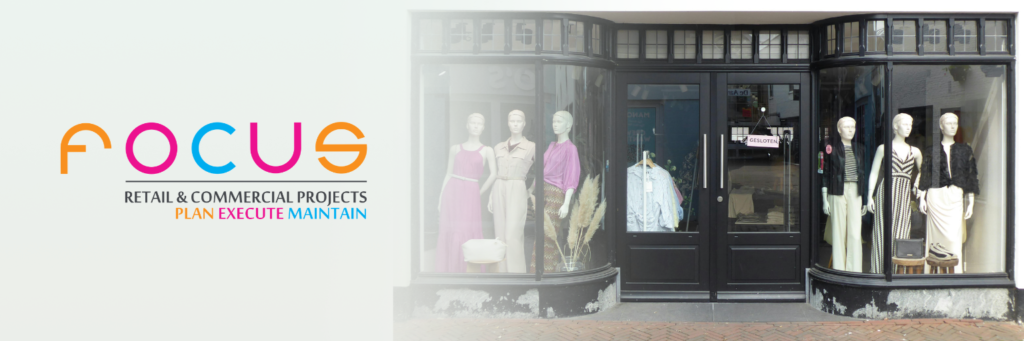
Minimalist shopfronts for premium brands
The minimalist approach to shopfront design is built on the principle that less is more. It uses clean lines, uncluttered compositions, high-quality materials, and often a monochromatic colour palette to create a sense of sophistication and exclusivity. This style strips away all non-essential elements, forcing the focus onto a single, hero product or a powerful branding element.
Key elements: Frameless floor-to-ceiling glass, concealed lighting, natural materials like stone or polished concrete, and a significant use of negative space. Signage is often subtle, perhaps an elegantly backlit logo or a simple, refined font.
Psychology: This design communicates confidence and quality. By not shouting for attention, it suggests that the products within are so exceptional, they speak for themselves. It appeals to a discerning customer who values craftsmanship and an uncluttered aesthetic.
Best for: High-end fashion boutiques, luxury jewellers, art galleries, and premium technology stores. The iconic Apple Store is a global example of this philosophy in action.
Biophilic shopfronts that draw people in
Biophilic design, which incorporates natural elements into architecture, is a major trend in modern wellness and retail design. A biophilic shopfront uses living plants, natural materials, and organic forms to create a calming, inviting, and vibrant facade. For a practical framework of the patterns behind this approach, 14 Patterns of Biophilic Design is a useful reference point.
Key elements: Living green walls, large planters with lush foliage, natural timber cladding, stone textures, and large windows that blur the line between inside and out.
Psychology: This approach taps into our innate connection to nature, creating a sense of tranquility and well-being. It signals that the brand is healthy, sustainable, and authentic. In a harsh urban environment, a green oasis is a powerful magnet for attention and provides a welcome visual rest. This aligns with the principles explored in our guide to sustainable shopfitting.
Best for: Wellness brands, organic cafes, florists, eco-conscious retailers, and any business wanting to project a fresh and natural identity.
Interactive shopfronts with digital impact
This type of shopfront design uses technology to create a dynamic and engaging experience. It moves beyond static displays to create a facade that can change, react, and communicate in real-time.
Key elements: High-resolution Light-Emitting Diode (LED) screens, interactive touch displays, projection mapping onto the glass or building facade, and integrated audio.
Psychology: An interactive front creates a sense of excitement and modernity. It provides an opportunity for retailtainment, drawing customers in with movement and novelty. It also allows for unparalleled flexibility, enabling a store to change its entire window display from a new product launch to a seasonal promotion with the click of a button. A deeper look at practical fitout considerations sits in our piece on integrating technology into your fitout.
Best for: Sportswear brands, electronics stores, entertainment retailers, and any brand targeting a younger, tech-savvy demographic.
Art-led shopfronts that spark curiosity
This approach treats the shopfront not as a window, but as a stage or an art gallery. It uses bold, artistic, and often abstract installations to create a powerful visual statement that piques curiosity.
Key elements: Custom sculptures, dramatic lighting effects, bold colour blocking, and collaborations with local artists. The focus is less on displaying specific products and more on creating a memorable and shareable visual moment. Major brands often use this approach, as documented in design publications like Frame Magazine.
Psychology: An artistic shopfront signals creativity, innovation, and confidence. It makes the brand feel culturally relevant and interesting. It generates intrigue, making people stop and wonder what kind of unique experience awaits them inside. It is also highly Instagrammable, encouraging social media sharing and user-generated marketing.
Heritage shopfronts that build trust
For businesses located in historic buildings, the best approach is often to honour and enhance the existing architecture. This design leverages the character and authenticity of the building itself to create a sense of permanence and timeless quality.
Key elements: Restoring original brickwork or tiles, using classic signage techniques like hand-painted lettering or gold leaf, and installing elegant awnings. The window display itself might be more traditional, showcasing products in a refined, curated manner.
Psychology: This style communicates stability, tradition, and craftsmanship. It suggests that the business has a long-standing commitment to quality. It can create a warm, nostalgic, and trustworthy impression that is particularly effective for artisanal or heritage brands.

Your shopfront is your first and best opportunity to make an impression. Choosing the right design direction requires a deep understanding of your brand, your customer, and your location. It also helps to map the shopfront direction to the practical requirements of commercial fitouts so the concept can be delivered cleanly on site.
Feeling inspired to create a shopfront that truly represents your brand? Our team at Focus Shopfit specialises in crafting unique and effective retail facades. Let's discuss your vision by getting in touch through our contact page.