
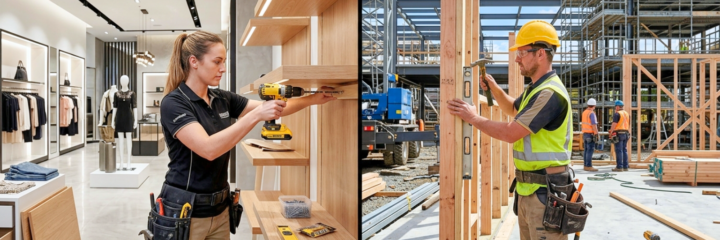
Do you need a shopfitter or a builder for your commercial fitout?
Business owners commissioning a retail or commercial fitout for the first time regularly ask whether they need a shopfitter or a builder. Both work in construction, both manage trades, and both will provide a quote for the same project.
The differences are significant enough to affect the outcome, the cost, and the experience of getting there. The questions below cover what actually distinguishes the two and how to apply that distinction to your specific project.
-
What is the fundamental difference between the two?
The distinction between a shopfitter and a builder reflects a fundamentally different scope of expertise and commercial experience that directly affects how well a retail or commercial fitout performs in practice, not simply a difference in licence category.
A builder is licensed and experienced across a broad range of construction types, from residential housing to commercial buildings to industrial structures. Their expertise is structural, and their commercial model is typically project-based. Builders manage large-scale structural works efficiently. What they are not optimised for is the interior fitout of a retail or commercial tenancy, where the work is smaller in structural terms but far more demanding in terms of finishes quality, trade sequencing, joinery precision, and brand specification.
A shopfitter is a commercial fitout contractor whose entire operation is oriented around fitting out retail, hospitality, healthcare, and commercial spaces. The distinction is specialisation, not licensing category. A shopfitter's supply chain includes joinery workshops, proprietary display systems, shopfront fabricators, and fitout-specific subcontractors who work to the tolerances that retail and commercial interiors require.
-
Does licensing actually differ between the two in Australia?
In most Australian states, the underlying licence category is the same or similar. In Queensland, both categories operate under a Queensland Building and Construction Commission (QBCC) Builder (Commercial) licence. In New South Wales (NSW), commercial fitout work is carried out under a contractor licence issued by NSW Fair Trading. In WA, the Building Services Board issues contractor licences for building work.
What matters practically is whether the contractor holds the right licence for the specific trades in your project scope. A fitout involving structural modifications, fire system alterations, or plumbing works requires licences for each of those categories. Always request licence details for each applicable trade and verify them with the relevant authority. For Queensland projects, the QBCC provides an online licence verification tool.
-
When should you choose a shopfitter over a builder?
Choose a shopfitter when your project is a commercial interior fitout of an existing tenancy or building. This covers retail stores, hospitality venues, medical clinics, pharmacies, gyms, and offices; all spaces where the core scope is joinery, ceiling systems, wall finishes, trade fitoffs, flooring, shopfronts, and signage. A builder is the right choice when your project involves primary structural construction: a new commercial building, a substantial addition, significant civil works, or a project that is primarily structural rather than interior fitout in nature.
The grey area is a fitout that requires meaningful structural works as part of the interior fit, such as removing load-bearing walls, adding a mezzanine, or installing a lift. A shopfitter with structural capability, or a shopfitter working alongside a structural subcontractor, is typically the appropriate engagement in these cases.
-
How does the cost comparison work in practice?
A builder quoting a fitout project is not necessarily cheaper. Builders operating outside their core competency often underestimate the precision requirements of retail and commercial interiors, and they either qualify their prices heavily or encounter quality issues on site. A shopfitter who understands the exact scope of a retail fitout will produce a more accurate and more competitive price for that scope.
Knowing what is included in a shopfit and what drives price variation is worth establishing before seeking any quotes. A detailed breakdown of fitout pricing across retail and commercial categories in 2026 covers shopfitter market pricing and is a useful benchmark for interior fitout projects across Australian capital cities.
-
What makes shopping centre fitouts a specialist category?
Shopping centre fitouts are a category where shopfitter expertise is not optional. Centres have detailed fitout guidelines, approved contractor lists, and base building interface requirements that must be followed precisely. They conduct design reviews and site inspections during construction. Contractors unfamiliar with centre requirements cause delays at every approval stage and create friction with centre management throughout the project.
Many of the issues that arise when the wrong contractor type is engaged are the same ones that derail retail fitout projects more broadly. The most common retail fitout mistakes and how they happen is relevant reading before selecting any contractor for a centre fitout.
-
How do you evaluate a shopfitter's actual capability?
Capability assessment for a shopfitter should focus on three areas: completed project portfolio in your sector, trade subcontractor relationships, and joinery capability. A shopfitter with a strong portfolio in your sector, established subcontractor relationships across all required trades, and in-house or direct-control joinery will deliver a more consistent result than a coordinator who outsources everything.
Ask for client references from projects similar to yours in scale and sector, and speak with those clients specifically about programme delivery, variation management, and finished quality. The same evaluation criteria apply whether you are engaging shopfitters in Brisbane or any other Australian city; the framework is universal even if the local regulatory context differs.
-
What does a national shopfitter offer that a local builder cannot?
For businesses operating across multiple Australian states, a national shopfitter offers consistency that no local contractor can provide. Brand standards, fitout specifications, and programme management are applied consistently whether the project is in Perth, Sydney, Brisbane, or Melbourne. The supply chain is centralised, reducing price variation between markets, and a single point of contact manages delivery nationally.
Focus Shopfit has operated nationally since 1984 from offices in Perth and Auburn. The delivery approach across retail, hospitality, healthcare, and commercial fitout is covered across the Plan, Execute, and Maintain service pages.
For business owners approaching this decision for the first time, a plain-language explanation of what a shopfit includes from design through to defects liability is useful preparation before seeking any quote.
Focus Shopfit has been delivering specialist retail and commercial fitouts nationally since 1984. To work out whether a shopfitter or a builder is the right fit for your project, put your brief to our team and start the conversation.


What the design and construct model means for your shopfitting project
The design and construct (D&C) model is widely used across Australian shopfitting and commercial fitout, and for good reason. A single contractor takes responsibility for both design and delivery, which concentrates accountability, compresses the programme, and removes the coordination friction that causes disputes in traditional delivery models. The key characteristics of the model are these:
- A single contractor takes responsibility for both design and construction
- The client brief replaces a full set of architectural drawings as the starting point
- Design, pricing, and programme are developed together rather than in sequence
- Accountability for design errors and construction performance sits with one party
- Variations caused by design discrepancies are substantially reduced

What design and construct actually means
In a design and construct shopfitting engagement, the contractor carries both the design liability and the construction obligation, which concentrates accountability in one party and removes the coordination gaps that generate disputes and cost overruns in traditional delivery models.
In a traditional design-bid-build model, the client engages an architect or designer separately, develops a full set of drawings and specifications, then sends those documents to contractors for tender. The contractor prices what the drawings say. If the drawings are incomplete, the contractor qualifies the price. If the design does not work on site, the parties argue about who is responsible for the discrepancy.
The D&C shopfitting model removes this separation. The client engages a D&C shopfitter who takes the brief, develops the design to a level that satisfies council and landlord requirements, and commits to a fixed or negotiated price encompassing the full scope. From that point, the contractor owns the outcome.
The brief still needs to be thorough. Vague briefs lead to designs that miss the mark, and changes after design lock-in generate cost. The Australian Institute of Architects (AIA) provides guidance on what a thorough design and documentation phase involves, which gives useful context when comparing the depth of process offered by different D&C shopfitters.
How the process unfolds
The client provides a brief covering the scope of works, any fixed requirements such as brand standards or landlord fitout guidelines, the budget range, and the required programme. The contractor develops concept designs, seeks client feedback, and refines them to a schematic design that confirms the cost approach.
Schematic design is then developed to design development, providing enough detail to submit to the landlord for approval and, where required, to council for development application (DA) or building permit. Once approvals are obtained, construction documentation is completed and the project moves to site. How the execution phase is structured and where accountability sits is worth reviewing before briefing any contractor.
During construction, the D&C contractor manages all trades, provides site supervision, coordinates inspections, and is responsible for delivering to the agreed scope, quality, and programme. Practical completion triggers handover, at which point the client takes possession and the defects liability period begins.
When D&C shopfitting is the right model
D&C suits business owners who have a clear concept of what they want but no time or inclination to manage a separate design process. National retailers with established brand standards who need consistent delivery across multiple sites are a strong D&C fit. Businesses where the scope is relatively well defined, such as a pharmacy, a dental clinic, or a food retail outlet in a standard tenancy, also benefit from the single-point accountability structure.
D&C is less suited to highly complex architectural projects where the design itself is a significant part of the brief and the client wants direct input at every stage. In those cases, engaging an independent architect for design and a contractor for construction can give more design control, at the cost of a more complex delivery structure.
Understanding what professional project management actually delivers within a D&C engagement is worth clarifying with any contractor on your shortlist. What a properly run retail fitout project management process looks like covers the key questions to ask when evaluating any contractor's approach.
Risks and how to manage them
The D&C model transfers design risk to the contractor. This is an advantage when the contractor is experienced and genuinely capable in design. A D&C shopfitter that is competent in construction but weak in design can produce a technically compliant fitout that performs poorly commercially or creates operational inefficiencies that only become apparent after opening.
Due diligence before engaging a D&C shopfitter should include reviewing a portfolio of completed projects in your sector, speaking with previous clients about the design process specifically, and assessing whether the contractor has genuine in-house design capability.
A clearly drafted D&C contract that specifies the client brief, confirms the design approval process, identifies the conditions for variations, and sets out programme obligations reduces the risk of disputes. Working through a structured fitout scope checklist before engaging any contractor ensures the scope is well defined before any agreement is signed.
The D&C model at Focus Shopfit
Focus Shopfit has operated as a design and construct shopfitter since 1984. Our model integrates in-house design, trade management, and project delivery under a single commercial relationship. The planning phase is where the client brief is translated into a design, budget, and programme that the delivery team can execute with confidence.
Operating from Perth and Auburn, we deliver D&C fitout projects nationally across retail, hospitality, commercial, and healthcare sectors. Post-handover, our Maintain service supports the fitout investment over its full trading life.
For context on what the full project lifecycle looks like from brief to opening day, a realistic breakdown of each fitout phase and how long each takes walks through the phases with realistic timeframes.
Focus Shopfit has been delivering D&C fitout projects across Australia since 1984. If you are weighing up whether D&C is the right model for your project, get in touch with our team to talk it through before you commit to any engagement structure.
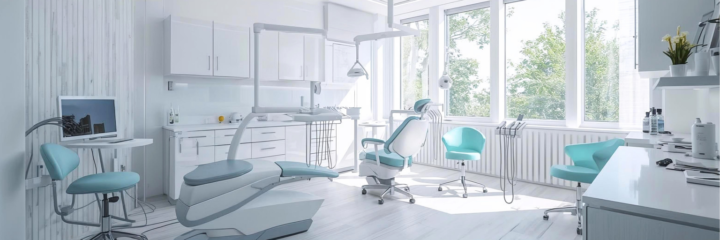
How to design a dental fitout in Perth that meets compliance and patient needs
Dental fitouts are among the most technically demanding projects in the commercial fitout industry. Every design decision has compliance implications. In Perth, the regulatory environment adds Western Australia (WA)-specific requirements to national standards, and demand for new dental premises in the metro area has grown with population expansion in the northern and southern corridors.
The decisions covered below are the ones that most directly determine project cost, compliance outcome, and patient experience. They need to be made before construction begins, not during it.

The core challenge: Compliance and experience working together
A dental fitout in Perth must reconcile clinical compliance requirements with patient experience design, and the practices that do this well consistently outperform those that treat the two as separate problems to be solved by different teams at different stages.
Practices that separate these priorities produce fitouts that underperform on at least one dimension. The spatial planning that satisfies infection control standards can also create a clear patient journey. The material selection that meets sterilisation-grade requirements can also communicate cleanliness and calm to anxious patients. Getting this right requires a fitout team that understands both dimensions from the brief stage.
For a benchmark of what a high-specification healthcare fitout looks like when these priorities are resolved well, a walkthrough of a completed high-end medical fitout in Perth illustrates the standard of finish and compliance detail that a capable fitout team delivers.
Clinical zone planning
- Treatment room configuration
Treatment rooms in a dental fitout require minimum clear floor areas that allow a dentist, assistant, and patient chair to operate without obstruction. A practical minimum is 11 to 14 square metres per operatory, depending on whether a dedicated cabinetry wall, mobile delivery unit, or built-in dental unit is specified. Room orientation affects operability; natural light is desirable for patient comfort but creates glare conflicts with the operating light. Where possible, position the patient chair with a north or east aspect to allow natural light without direct sun exposure during treatment hours.
- Infection control zoning
Australian Standard (AS)/NZS 4187 governs reprocessing requirements for reusable medical devices in healthcare settings. For dental fitouts, the sterilisation area must be designed as a defined zone with unidirectional workflow: contaminated instruments enter on one side, and clean and sterile instruments exit on the other. Cross-contamination between dirty and clean zones is a compliance failure. The sterilisation room should be physically separated from treatment areas by at least a wall and door, and air flow direction should move from clean to contaminated zones.
- Staff circulation and cross-contamination prevention
Staff movement between treatment rooms and support areas must be planned to prevent contaminated materials from passing through clean spaces. For practices with four or more operatories, a staff corridor that is separate from patient-facing areas is worth the additional floor area. This affects the location of the sterilisation room, waste disposal points in each treatment room, and the design of the reception-to-clinical boundary.
Infrastructure requirements
- Dental services and gas
Each treatment room requires a compressed air supply at a minimum of 700 kPa at point of use, suction systems covering high-volume evacuation and saliva ejector, medical-grade gases if nitrous oxide (N2O) is used, and water supply for the dental unit. The technical routing of these services through the floor and wall structure must be confirmed before construction begins. Amalgam separator requirements apply in WA under environmental protection regulations, and new fitouts should include amalgam separation in the drainage specification from the start.
- Electrical and data infrastructure
Modern dental equipment is data-intensive. Digital radiography units, intraoral cameras, patient management systems, and practice software all require structured data cabling and reliable power supply. Over-specifying data and power points at the construction stage is significantly cheaper than retrofitting after handover. X-ray room design requires radiation shielding assessment; under WA's Radiation Safety Act 1975, dental radiography equipment requires Radiological Council of WA approval and a shielding design signed off by a qualified radiation physicist before construction begins.
- HVAC and air quality
Dental procedures generate aerosols that present an infection control risk. Heating, ventilation, and air conditioning (HVAC) design for a dental fitout should include air filtration appropriate for clinical environments and ensure air is not recirculated between treatment rooms. Ventilation requirements for healthcare-classified spaces are governed by the NCC provisions published on the Australian Building Codes Board (ABCB) portal, which is the authoritative reference for compliance.
Patient experience design
- Reception and waiting areas
The reception and waiting area is the patient's first physical experience of the practice. Design decisions here communicate positioning, cleanliness, and approachability before any clinical interaction occurs. Key considerations include:
- Reception counter design: a lowered section for wheelchair users is both accessible and more welcoming than a uniformly elevated counter
- Acoustic separation: dental procedure sounds should not be clearly audible in the waiting area
- Seating materials: cleanable, visually comfortable, and without appearing clinical or institutional
- Lighting: warm white tones in waiting areas contrast deliberately with the cooler, brighter lighting in treatment rooms, reinforcing the psychological transition between comfort and procedure
- Patient anxiety and environmental design
Dental anxiety affects a significant proportion of adult patients. Fitout design that reduces visible clinical cues in patient-facing areas, minimises noise transfer, and creates a calm, navigable environment contributes directly to patient retention and referral behaviour. The same principles that drive purchasing behaviour in retail, covered in depth in this analysis of how colour choices affect customer psychology, apply with direct relevance to the patient-facing zones of a dental practice.
Regulatory and compliance requirements in Perth
Commercial building works in WA require approval under the Building Act 2011. For dental premises, this typically means a building permit is required, and a building surveyor must certify compliance with the NCC and relevant Australian standards. Healthcare premises may also trigger referral to the WA Department of Health for premises approval under the Health (Miscellaneous Provisions) Act. Building certification requires documentation of fire safety compliance, accessible design under AS 1428, and electrical safety certification.
The Australian Human Rights Commission (AHRC) sets out what Disability Discrimination Act (DDA) compliance requires for premises open to the public. Accessibility requirements must be confirmed against the specific building class and occupancy type during the design phase.
Budget considerations
Dental fitout costs in Perth typically range from $2,500 to $5,000 per square metre for a standard 100 to 200 square metre tenancy. Radiation shielding, amalgam separation, compressed air systems, and specialist dental cabinetry are costs that do not appear in a standard commercial fitout and are frequently underestimated in early budgets. Working through a structured fitout scope checklist before engaging contractors is a practical way to surface these items before quotes are sought.
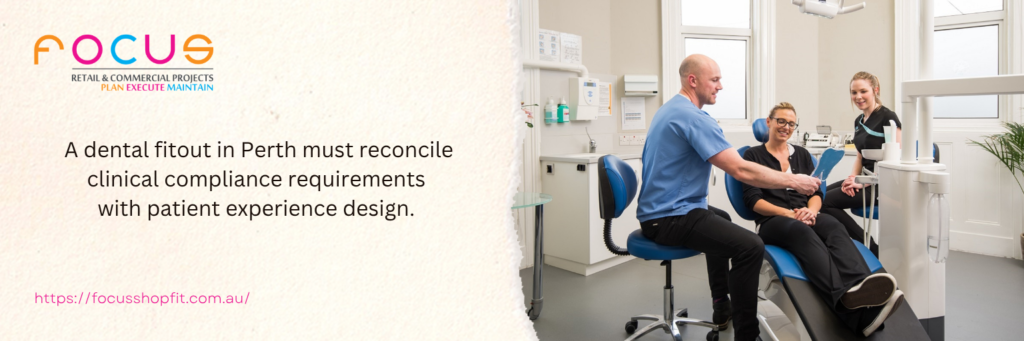
Focus Shopfit has been delivering healthcare fitouts nationally since 1984. To discuss your dental fitout in Perth or elsewhere in WA with a team experienced in clinical compliance and commercial delivery, reach out here and start the conversation.

A guide for 2026 cafe fitout cost in Australia
Cafe fitout cost is among the most searched questions in the hospitality fitout space, and the range is genuinely wide. The variables are significant, and the consequences of underbudgeting a hospitality project are severe. You cannot open with half a kitchen.
This guide breaks down what drives pricing, what a realistic pre-build checklist should include, and what the fitout process looks like from lease commitment to opening day.

What drives cafe fitout cost?
A cafe fitout cost in Australia can range from $1,500 per square metre for a basic espresso bar build through to $4,500 or more per square metre for a full commercial kitchen fitout with premium front-of-house finishes, and almost the entire gap between those figures is explained by kitchen specification.
Kitchen specification is the single biggest variable in any cafe or restaurant fitout budget. A simple espresso bar with a hot holding cabinet and a small prep bench has a completely different cost profile to a full commercial kitchen with ventilation, a commercial dishwasher, grease trap, stainless benching, walk-in cool room, and specialist gas services. The Food Standards Australia New Zealand (FSANZ) framework underpins the food premises standards that state-based registration and inspection requirements build on, and these compliance obligations affect fitout specification directly.
Other major cost drivers include tenancy condition at possession, council and food safety compliance requirements, ventilation and exhaust infrastructure, the extent of custom joinery, and premium materials and lighting fixtures. A national breakdown of what drives price variation across fitout categories gives useful benchmarks before any budget is finalised.
Before you sign the lease: What to confirm
The most expensive mistake in a cafe fitout is signing a lease before completing due diligence on the tenancy. Once you have committed, your negotiating position is gone. The following need to be confirmed before executing any lease or heads of agreement:
- The presence, size, and adequacy of existing grease trap infrastructure for your menu volume
- A mechanical services report on existing heating, ventilation, and air conditioning (HVAC) capacity; commercial kitchens add significant heat load
- Existing electrical board capacity; commercial kitchen equipment and refrigeration draw far more power than standard retail
- Whether a DA is required for change of use if the premises was not previously a food business
- Fire compliance status; commercial kitchens with gas service and deep fryers require specific suppression systems
- Landlord fitout requirements; shopping centre environments have prescriptive shopfront and base building interface standards
- Whether a landlord provides a fitout contribution and what the reimbursement structure is
- Gas availability at the tenancy or the cost of connection if it is not currently present
- Any heritage or planning overlays that may restrict modifications to the facade or shopfront
- The make-good schedule and what reinstatement will be required at lease end
Skipping this due diligence process is one of the most avoidable sources of delay and cost blowout in hospitality fitouts. A preparation guide covering what needs to be confirmed before construction begins is useful reading before any lease is signed.
Cafe fitout cost ranges by scope
The following ranges reflect 2026 market pricing for cafe fitouts across Australian capital cities. Costs are total project values including all trades, joinery, and finishes, excluding loose furniture, equipment, and operating licences:
- Basic espresso bar fitout (simple premises, existing services, limited kitchen): $80,000 to $150,000
- Mid-range cafe fitout (custom joinery, tiled floor, compact commercial kitchen, seating for 30 to 50 covers): $150,000 to $350,000
- Full-service cafe or restaurant fitout (complete commercial kitchen, custom joinery, feature finishes, 50-plus covers): $350,000 to $700,000 and above
These figures assume a tenancy of 80 to 150 square metres. Larger venues will scale proportionately, with kitchen costs remaining relatively fixed as floor area increases.
After construction: W hat needs to happen before you open
A cafe fitout is not complete when the builders leave. The following steps must be completed in sequence before trading can begin:
- Obtain final building certification or occupation certificate from the relevant certifying authority
- Register the food premises with your local council under applicable food safety legislation; registration is mandatory Australia-wide under the FSANZ framework
- Commission all gas appliances and obtain a gas compliance certificate from a licensed gasfitter
- Complete electrical final inspection and obtain certificates of electrical safety for all new work
- Have the ventilation canopy system commissioned and test airflow against design specification
- Conduct a food safety management review under your state's food standards framework
- Obtain a liquor licence through the relevant state liquor licensing authority if applicable
- Complete staff training on food safety, equipment operation, and emergency procedures
- Arrange a post-construction clean to commercial kitchen standard before first food preparation
- Conduct a soft opening to identify operational issues before public launch
The sequence matters as much as the items themselves. Trades not commissioned in the right order delay certification, and certification delays delay your trading start date. What the average shop fitout timeline looks like across all phases gives context on how each stage fits into the overall programme.
Making the cafe fitout budget work long-term
A hospitality fitout budget is not only about what the space looks like on opening day. Durability, maintenance cost, and operational efficiency all contribute to the long-term return. The staff workflow implications of a well-designed kitchen layout affect labour cost and service speed from day one, which means the planning and design process earns its value well before the first customer walks in.
Research from the Acoustical Society of America consistently identifies unwanted noise as one of the leading drivers of shorter customer dwell times in commercial hospitality environments. Acoustic design is worth including in the brief, not added as an afterthought once the space is complete.
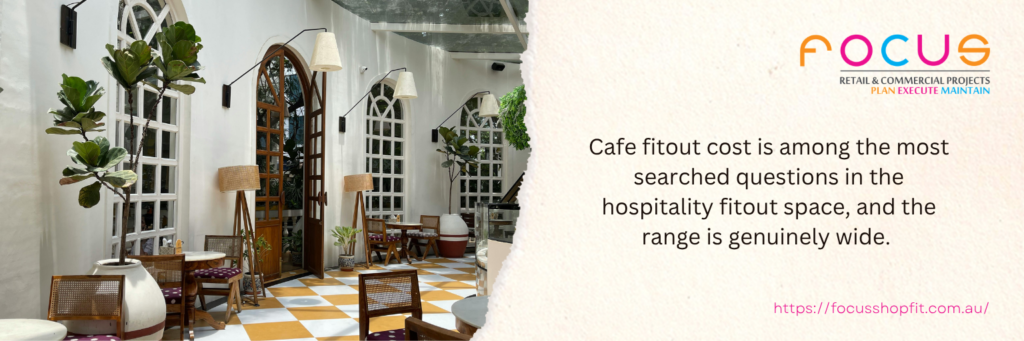
Focus Shopfit has been delivering hospitality fitouts across Australia since 1984. To get a realistic assessment of what your cafe or restaurant fitout involves before you commit to a site, speak with our team.
Choosing commercial flooring options for retail and hospitality
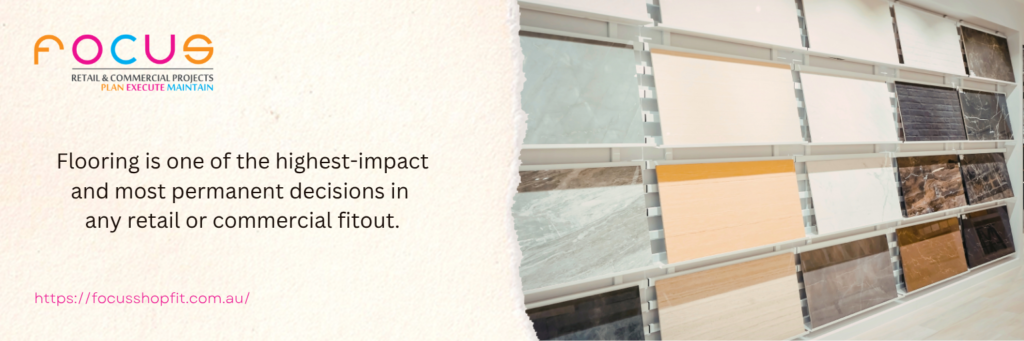
Flooring is one of the highest-impact and most permanent decisions in any retail or commercial fitout. A poor choice is expensive to reverse after handover. The right choice can perform for a decade or more with minimal maintenance.
This guide covers the main commercial flooring options available to Australian business owners, with a breakdown of where each material performs best, what it costs, and what its limitations are in practice.
Why flooring choice is a design decision, not a finishing decision
The right commercial flooring option affects acoustic character, customer dwell time, staff fatigue, and brand positioning simultaneously, which is why it needs to be resolved at the design stage rather than treated as a finishing decision made after everything else is locked.
Flooring also accounts for a meaningful proportion of the total fitout budget. Depending on the material and finish, floor coverings can represent 10 to 20% of project cost. Changing flooring after construction is expensive, disruptive, and requires coordination with other trades. Getting this decision right during the design phase matters considerably.
Australian Standard AS/NZS 4586 classifies slip resistance for commercial surfaces using wet and dry pendulum test values. Any flooring specified for commercial use must meet these minimums, and in wet areas the requirements are more stringent. The Australian Building Codes Board (ABCB) publishes the National Construction Code (NCC) provisions that govern these requirements by building class and occupancy type.
Polished concrete
Polished concrete is the dominant flooring choice for mid-to-high-end retail, showrooms, and contemporary hospitality fitouts across Australia. Its appeal is durability, low maintenance, and the visual neutrality it provides as a base for almost any retail aesthetic.
- Durability: exceptional, with appropriate densifier and sealer application
- Maintenance: periodic resealing every three to five years; minimal day-to-day effort
- Acoustics: hard and reflective; supplementary acoustic treatment often required in open-plan spaces
- Cost range: $80 to $150 per square metre installed, depending on subfloor condition and finish level
- Best suited to: fashion retail, homewares, food courts, showrooms, and contemporary office fitouts
- Limitations: cold underfoot; subfloor remediation can add significant cost if the slab is not in good condition
Luxury vinyl plank and tile (LVT/LVP)
Luxury vinyl plank (LVP) and luxury vinyl tile (LVT) have become the practical workhorse of the commercial fitout industry in Australia. Modern commercial-grade LVT is visually convincing, dimensionally stable, and available with wear layers up to 0.7mm suited to sustained high-traffic environments.
- Durability: good to excellent depending on wear layer specification; commercial-grade products rated for 100,000-plus foot traffic cycles
- Maintenance: damp mopping is sufficient for most applications
- Acoustics: better than hard surfaces; acoustic-underlay products can reduce impact noise transmission meaningfully
- Cost range: $50 to $120 per square metre installed
- Best suited to: pharmacy fitouts, medical clinics, aged care, mid-market retail, and offices requiring a timber visual at lower cost
- Limitations: not suited to extreme temperature variation or prolonged direct sunlight without ultraviolet (UV)-stabilised products
Ceramic and porcelain tile
Tile remains the standard for food service, healthcare, and any application requiring moisture resistance and rigorous cleaning. Porcelain's lower porosity and greater compressive strength make it the better choice where durability and hygiene are priorities.
- Durability: high; porcelain tiles properly installed will outlast most other finish elements in a fitout
- Maintenance: smooth, non-porous surfaces are straightforward to clean; grout lines require ongoing attention in food service environments
- Acoustics: poor inherently; hard reflective surfaces amplify ambient noise, requiring supplementary treatment
- Cost range: $70 to $200 per square metre installed for commercial-grade products
- Best suited to: commercial kitchens, bathrooms, entry lobbies, healthcare facilities, and food retail
- Limitations: installation time is longer than vinyl products
Carpet tile
Carpet tile remains the primary specification for commercial office fitouts and is increasingly used in premium hospitality environments where acoustic comfort is a design priority. Individual tiles can be replaced without full floor replacement when wear or damage is localised.
- Durability: moderate; commercial carpet tile with a bitumen or glass fibre backing performs well for eight to 12 years with appropriate maintenance
- Maintenance: regular vacuuming and periodic deep cleaning required
- Acoustics: strong, absorbing both airborne noise and impact sound
- Cost range: $40 to $100 per square metre installed for commercial specification products
- Best suited to: office fitouts, meeting rooms, hotel foyers, and boutique retail where warmth and quiet are valued
- Limitations: not appropriate for wet areas or food preparation environments
Timber and engineered timber
Solid and engineered timber deliver warmth and premium positioning that no synthetic product fully replicates. The trade-off is cost, maintenance requirement, and sensitivity to moisture.
- Durability: variable; solid hardwood can be resanded and refinished multiple times; engineered timber has a finite wear layer, typically three to six millimetres
- Maintenance: more demanding than hard synthetic surfaces; scratching is visible in high-heel traffic environments
- Acoustics: moderate; softer acoustically than tile or polished concrete, less absorbing than carpet
- Cost range: $90 to $250 per square metre installed for engineered products
- Best suited to: premium fashion retail, jewellery stores, boutique hospitality, and high-end offices
- Limitations: moisture-sensitive; not suited to areas with frequent wet cleaning or direct exposure to outdoor conditions
Rubber flooring and vinyl sheet
Rubber flooring is the specification standard for gym and wellness fitouts. Vinyl sheet is widely used in healthcare and aged care environments where infection control and seamless coverage are required.
- Durability: high in appropriate applications; rubber is slip-resistant, impact-absorbing, and durable under heavy equipment load
- Maintenance: straightforward; welded-seam vinyl sheet provides a hygienic, crevice-free surface
- Acoustics: rubber provides good impact absorption, which matters in gym fitouts above occupied spaces
- Cost range: $60 to $150 per square metre for commercial rubber; vinyl sheet typically $40 to $80 per square metre installed
- Best suited to: gym fitouts, yoga studios, healthcare facilities, and commercial kitchens
- Limitations: rubber's design range is limited; the aesthetic does not suit retail or hospitality environments
Selecting the right commercial flooring option for your project
The best flooring choice depends on the sector, traffic profile, maintenance budget, and brand positioning. A pharmacy fitout and a premium jewellery store require completely different specifications, and so do a commercial kitchen and an open-plan office.
Flooring decisions should be made in parallel with lighting specification. How a material looks in situ depends heavily on the colour temperature and intensity of the light source above it, which is why retail lighting principles and flooring selection need to be resolved together rather than sequentially.
Research from the Acoustical Society of America consistently identifies unwanted noise as the leading environmental complaint in commercial spaces. Flooring specification is one of the most effective acoustic levers available in a fitout, and its contribution should be assessed against the acoustic requirements of the space before material selection is finalised.
How flooring colour interacts with wall finishes, lighting, and merchandise display affects customer behaviour and dwell time. The relationship between colour, surface selection, and sales performance is covered in depth in this breakdown of colour psychology applied to retail environments.
Focus Shopfit has been specifying and installing commercial flooring as part of complete retail and commercial fitouts nationally since 1984. To discuss materials selection as part of a complete fitout scope, reach out to our team.
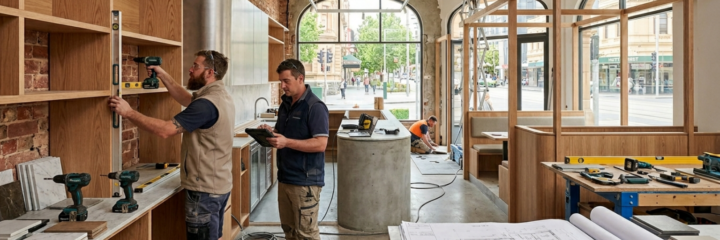
What the market and regulations actually look like for Adelaide shopfitting in 2026
Adelaide's commercial fitout market has shifted over the past 18 months. Vacancy rates across the CBD and key suburban strips have tightened, new food and beverage operators are filling spaces that sat idle through 2023 and 2024, and major retail landlords are investing in precinct upgrades that are drawing fresh tenancy activity.
For business owners planning shopfitting for Adelaide projects in 2026, the regulatory environment here differs from other Australian states in specific ways that affect both timeline and budget planning.
Phase 1: Reading the Adelaide market in 2026
Population growth in outer metropolitan corridors, including Mount Barker, Gawler, and Barossa access points, is generating demand for new retail and service businesses. The CBD fringe, particularly around the East End, Hutt Street, and the Bowden urban renewal precinct, is attracting both local independents and national operators seeking more affordable tenancy rates than Sydney or Melbourne.
Medical and allied health fitouts are performing strongly, sustained by Adelaide's demographic profile. Pharmacy operators expanding into South Australia need to confirm state-specific compliance obligations alongside the national Pharmacy Board of Australia standards before the design is finalised, as SA has its own premises requirements that differ from other states.
Hospitality fitouts have generated the most active enquiry across Adelaide in 2026. Neighbourhood precincts in Norwood, Glenelg, and Unley are recording strong new-business activity. Operators need fitouts that balance tight budgets against durable commercial interiors that hold up across a five-to-seven-year tenancy.
Phase 2: Navigating SA regulations and approvals
South Australia's Planning and Design Code replaced the previous system of individual development plans in 2021, and understanding how it applies to your tenancy type is essential before committing to a site or a construction timeline in Adelaide.
Under the Planning and Design Code, most standard commercial tenancy fitouts that are internal-only and do not alter the building envelope qualify as accepted development, meaning no DA is required. Works that change the use of the premises, affect the facade, or require building rule consent may trigger a formal approval pathway. For any fitout in a heritage-listed precinct, and Adelaide's CBD has a significant concentration of heritage buildings, additional consultation with Heritage SA is required before works affecting heritage fabric are approved.
South Australia's construction licensing framework, governed by the Building Work Contractors Act 1995, requires that any commercial fitout involving structural works, electrical, plumbing, or fire systems must be completed by contractors holding the appropriate licence. Licences are issued by Consumer and Business Services (CBS) SA, and checking a contractor's licence status before engagement is straightforward through the CBS register.
Accessibility requirements under the Disability Discrimination Act 1992 (DDA) must also be confirmed for the specific building class and occupancy type. The Australian Human Rights Commission sets out what DDA compliance requires for premises open to the public, and these requirements are not automatically satisfied by meeting Planning and Design Code conditions.
Phase 3: Selecting the right shopfitters Adelaide
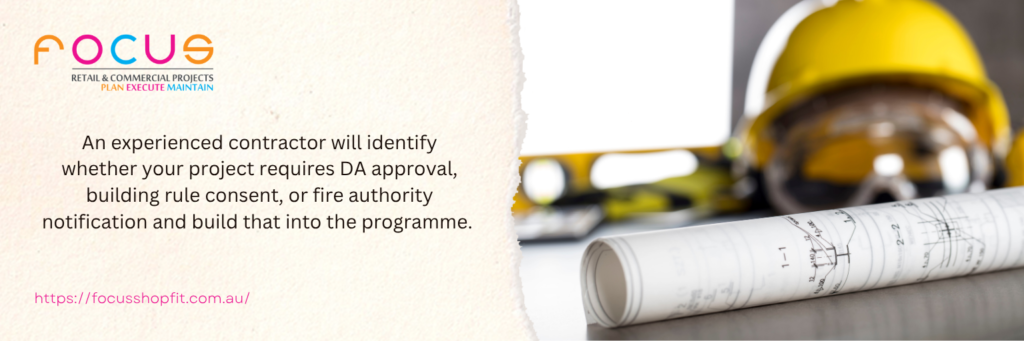
When briefing Adelaide shopfitters, being specific about the regulatory pathway from the first meeting saves considerable time. An experienced contractor will identify whether your project requires DA approval, building rule consent, or fire authority notification and build that into the programme. Contractors who do not flag these requirements early generate delays and cost surprises once construction is underway.
Adelaide's older building stock, which includes a significant volume of 1960s and 1970s commercial buildings in the outer suburbs, warrants a services condition survey before scope is finalised. Electrical boards, plumbing configurations, and ceiling services may require upgrading. Addressing this in the brief is far cheaper than addressing it through variations.
For multi-site operators needing consistent delivery across states, Focus Shopfit's national approach to project management covers how accountability is maintained across concurrent projects in different cities.
Phase 4: The fitout delivery process
Focus Shopfit's three-phase model, covering Plan, Execute, and Maintain, resolves SA-specific regulatory requirements during the planning phase, before a single trade is engaged. Building rule consent applications, accessibility audits, and heritage consultations are managed here rather than discovered mid-construction.
For projects in Rundle Mall tenancies or within the Adelaide Central Market Arcade, additional landlord fitout guidelines prescribe base building interface standards, approved materials, and shopfront requirements. Obtaining these documents from the landlord and reviewing them before the design is finalised prevents rework at the documentation stage.
Understanding what a fitout process involves end-to-end before committing to a timeline is worth doing early. A realistic breakdown of each phase and how long each takes helps frame what is achievable between lease execution and opening day.
Phase 5: Budget benchmarks for a 2026 Adelaide fitout
Fitout costs in Adelaide sit broadly in line with national market rates, though builder margins and subcontractor pricing vary depending on trade availability. The market here is smaller than Sydney or Melbourne, and heavily concurrent pipelines in hospitality can affect joinery and specialist trade lead times.
For medical or dental fitouts, compliance costs associated with hygiene-grade finishes, plumbing infrastructure, and specialist gas services push costs above standard retail rates. National pricing benchmarks across fitout categories give a useful reference point, with Adelaide generally sitting in the mid-range of Australian capital city pricing.
Landlord incentives in Adelaide are generally less generous than in Sydney or Melbourne, reflecting lower prevailing rents. Business owners should build the full fitout budget independently of any contribution offered and treat any landlord incentive as a partial offset.
Focus Shopfit has been delivering fitouts across South Australia since 1984. To talk through your project with a team that understands the SA regulatory environment from site through to handover, get in touch here and start the conversation.

What are the hidden costs in a commercial fitout budget?
Getting a commercial fitout budget wrong is one of the most common and costly mistakes a business owner can make. The builder's quote looks reasonable, the project gets underway, and then a succession of costs nobody mentioned at the start begins eroding the contingency.
This guide answers the questions most business owners wish they had asked before committing to a project, covering every significant hidden cost in a commercial fitout budget and what you can do about each one before it becomes a problem.
- What does a base fitout quote actually include?
Most fitout quotes cover the core scope: demolition, framing, joinery, ceiling systems, flooring, and the trade finishes your brief specifies. What they do not automatically include is everything required to make that work compliant, connected, and operational.
A base quote rarely covers council development application (DA) fees, building certification, fire compliance upgrades, or acoustic treatments required under the National Construction Code (NCC). Landlord fitout requirements, particularly in shopping centres, add further cost through prescriptive base building interface standards. Before comparing quotes, confirm exactly what scope each contractor has priced and what they have excluded.
- Are council approvals a separate commercial fitout budget item?
Yes, and the amounts vary significantly by jurisdiction and building type. A DA for a commercial fitout in a heritage-listed zone in Sydney can take four to six months and cost several thousand dollars in assessment fees alone. In Melbourne, Heritage Victoria overlays apply to a significant proportion of CBD and inner-suburb commercial buildings. In Queensland, commercial works fall under the licensing framework administered by the Queensland Building and Construction Commission (QBCC), which carries its own compliance obligations.
Even where a DA is not required, a certifier must issue either a certificate of occupancy or approval under a complying development pathway. Budget for professional fees at this stage. They are not optional, and they are not covered by the builder's quote.
- What are make-good obligations? Why do they affect the budget upfront?
A make-good clause in a commercial lease requires restoring the tenancy to a defined condition at the end of the term. The fitout budget impact is not just an end-of-lease concern. It affects design decisions at the start of the project. A fitout that installs permanent walls, modifies the base building ceiling grid, or changes electrical infrastructure creates obligations that are expensive to reverse. The Australian Building Codes Board (ABCB) publishes guidance on how NCC provisions apply to tenancy works, which gives useful context when reviewing your lease obligations.
- Where do trade costs most often blow out?
Electrical, plumbing, data, and HVAC are the trades most likely to exceed initial estimates. The causes are consistent:
- Existing services are in different locations than assumed at tender stage
- Council or a certifier requires additional fire-rated penetrations during the approval process
- The base building HVAC lacks adequate capacity for the fitout configuration
- Data cabling requirements increase once IT infrastructure is fully specified
The most common electrical blowout is an inadequate switchboard. If the tenancy was previously used for a lower-load business, the existing board may not support a commercial kitchen, medical-grade equipment, or high-density retail lighting. A pre-construction services audit by a licensed electrician is worthwhile before any budget is finalised.
- Is a contingency genuinely necessary?
A contingency allowance of 10 to 15% of your total commercial fitout budget is standard for a reason: unforeseen conditions appear on almost every project, and they are cheapest to handle when money is already set aside for them.
Even in a well-documented tenancy, builders encounter concealed services, non-compliant existing works, structural conditions that differ from plans, or asbestos in older buildings. Each triggers a variation at a point when your negotiating position is weakest. A 10% contingency is appropriate for a straightforward fitout in a modern building. For heritage buildings, older retail strips, or complex medical fitouts, 15% is more realistic. This commercial fitout checklist is one of the most effective ways to surface these risks before they become unplanned costs.
- How do landlord contributions affect the overall budget calculation?
Many commercial landlords offer a fitout contribution or incentive when securing a new tenant. The mistake is treating this as covering the full fitout cost. In practice, contributions cover base works only. Premium materials, custom joinery, technology integration, furniture, fittings, and equipment (FF&E), loose furniture, and signage sit outside the contribution scope. Contributions are also typically structured as reimbursements rather than upfront payments, which has cash flow implications that affect overall project financing.
- What line items aremost commonly missedin early budgets?
These items consistently appear outside early-stage budgets and create surprises during or after construction:
- Signage and wayfinding, which have lead times and costs that need to be planned alongside the fitout
- Loose furniture and FF&E, which are outside the builder's scope but essential for day-one operations
- IT and audio-visual (AV) hardware, where cabling is in trade scope but equipment, installation, and commissioning are not
- Post-construction cleaning to a trade-ready standard, since the builder's scope covers construction waste removal only
- Temporary trading costs where the business must operate from a secondary location during the build
For a clear picture of what drives cost variation across different fitout categories nationally, current 2026 pricing benchmarks across retail sectors help sense-check any early budget assumptions.
- Does building age affect the commercial fitout budget?
Older buildings carry more risk. Services that predate modern standards may require upgrades before the fitout can proceed under the NCC. Asbestos is present in a material proportion of buildings constructed before 1985, and removal by a licensed contractor under Safe Work Australia guidelines can add $5,000 to $50,000 or more, depending on the extent of the material. Heritage buildings in Melbourne and Sydney add further complexity, requiring heritage authority approval and restricting what can be modified.
- What is the most effective way to control hidden costs?
Investing in the design and documentation phase before seeking quotes is the single most effective control. Contractors price what they can see. Gaps in documentation become gaps in the quote, and those gaps are filled through variations at rates that are never in your favour. Understanding how a fitout investment translates into long-term commercial return helps frame these decisions correctly, and there is a detailed breakdown of the return on a professional fitout that is worth reviewing before any major commitment.
How Focus Shopfit structures the planning and execution phases to protect your budget is covered across the Plan and Execute service pages.

Focus Shopfit has been managing commercial fitout projects nationally since 1984. If you want to build a realistic budget before committing to a lease or a contractor, start the conversation with our team here and get a clear picture of what your project involves.

How to prepare a business for a commercial fitout with minimal downtime
A commercial fitout is one of the more significant operational events a business will go through. The construction period carries real risk to revenue, staff productivity, and customer relationships. Most of that risk is manageable when planning begins well before the first tradesperson arrives on site. This commercial fitout checklist provides a useful starting framework for mapping out what needs to happen before construction begins and what needs to be confirmed before trading resumes.
What follows is a practical preparation guide structured as two checklists: one for the weeks leading up to construction, and one for the period between practical completion and your doors reopening. Each item represents a decision or action that, if left unaddressed, typically surfaces as a more expensive and more disruptive problem during or after the build.

Before construction begins: Preparation checklist
Work through each of the following in the weeks leading up to your construction start date. The earlier each item is addressed, the more options you will have when something needs to change.
- Confirm your construction start and end dates in writing, and review the programme milestones in between. Make sure you understand which milestones represent genuine progress and which are buffer periods. The Australian Building Codes Board provides guidance on the approval and certification stages that make up a compliant fitout process, which is useful context when reading the programme your shopfitter provides. If any phase looks implausibly short, ask for an explanation before construction starts.
- Decide whether you will trade during construction, operate at a reduced capacity, or close fully for the duration. This decision shapes your staffing requirements, your customer communication plan, and your stock management strategy across the construction period. Reviewing common fitout mistakes to avoid before making this call highlights the planning oversights that most often cause disruption to businesses trading through a fitout.
- Communicate the fitout to your customers well in advance across all active channels, including in-store signage, email, and social media. Customers who feel informed are substantially more forgiving of temporary inconvenience than those who arrive unexpectedly to find access restricted or trading suspended. Framing the fitout as an investment in improving their experience goes a long way toward maintaining goodwill across the construction period and building anticipation for the reopening.
- Audit your stock and plan around the construction programme. If display fixtures or shelving are being replaced, establish where stock will be held during construction. Options include running down inventory deliberately in the weeks before the build starts, using off-site storage for the duration, or consolidating stock into a back-of-house area that will not be affected. For context on the scope of work involved and what is typically included in a shopfit of your type, the 2026 price guide for shop fitouts in Australia details how scope and cost vary across different fitout categories.
- Brief your staff early and establish a clear communication channel between your nominated project liaison and the fitout team's project manager. Staff who understand what is happening and when are better positioned to manage customer expectations throughout the construction period. They should know what areas are off-limits, what noise and disruption levels to expect on different days, and how to redirect customer enquiries about the new space.
- Review your lease and confirm what landlord approval requirements apply to the construction works. In shopping centres, all fitout work must be approved by centre management before any construction begins, and approved contractors must comply with the centre's construction management protocols. Your shopfitter should manage this approval process, but tracking its progress is the tenant's responsibility. Master Builders Australia provides guidance on tenant obligations and contractor responsibilities during commercial fitout works, which is useful background for any business owner going through this process for the first time.
- Arrange temporary facilities for staff if the fitout affects amenities including bathrooms, kitchen areas, or break rooms. If the premises will be fully closed during construction, confirm staff entitlements under the relevant enterprise agreement or award, and arrange for temporary redeployment to other locations where that is an option.
- For businesses in food and beverage, health, or any sector where hygiene standards and regulatory requirements apply to the trading environment, confirm with your fitout team how the construction zone will be physically separated from any areas that remain operational. Trading through a fitout in these environments requires careful planning and documented risk management. The ROI of a professional fitout covers why proper planning at this stage directly protects the financial outcome of the project.
Why the pre-build phase matters more than most businesses realise
Most fitout disruption is not caused by the construction itself but by decisions that were not made before construction started. The choice to trade through the build without a clear customer communication plan. The stock audit that was deferred and then became a crisis when shelving was removed ahead of schedule. The landlord approval that was assumed to be in progress but had never been formally submitted. Each of these is avoidable, and each is substantially easier to manage when it is identified as a decision point before the start date rather than as a problem during the build.
The preparation checklist above is designed to bring each of these decision points into view early enough to be managed properly. It is not exhaustive, but it covers the items that most commonly create problems for businesses during commercial fitout works.
Before the doors open again: Reopening checklist
Practical commercial completion is not the same as ready to trade. Practical completion means the construction is substantially finished and the premises can be occupied. It does not mean every defect has been resolved, every regulatory certificate has been received, or every system has been commissioned. Work through the following before opening to customers:
- Obtain all certificates of compliance from trades including electrical, plumbing, and gas, and file them with your lease documentation.
- Complete a formal defects walkthrough with the project manager and document every item requiring rectification, with agreed completion dates confirmed in writing before keys are accepted.
- Merchandise stock in the new layout with all staff briefed on changes to product placement, operational workflows, and any new systems or features in the space.
- Brief all staff on the new space before customers arrive, covering layout changes, updated service pathways, and how to use any new equipment or technology installed during the fitout.
- Arrange photographer access before opening to capture the new space for use across marketing channels, the website, and social media, while the space is clean and fully merchandised.
- Review the fitout process against the final outcome and document observations useful for planning future projects, including what worked well and what you would manage differently next time.

After opening: Post-fitout support
The weeks after opening are when minor issues surface that were not apparent during the handover walkthrough but become visible under trading conditions. Lighting that works differently with the floor full of people. A joinery door that requires adjustment once the air conditioning has cycled for a few weeks. Small defects that only appear once the space is in regular use. Focus Shopfit's maintenance service provides post-handover support covering warranty management, preventive maintenance, and reactive maintenance so that issues discovered after opening are resolved promptly without becoming operational headaches.
If you would like help structuring a fitout planning process that protects your business during construction, reach out to the Focus Shopfit team. Addressing these decisions before the start date is the most effective way to reduce disruption and protect the trading performance of your business throughout the project.

A guide to successful restaurant fitouts in Melbourne
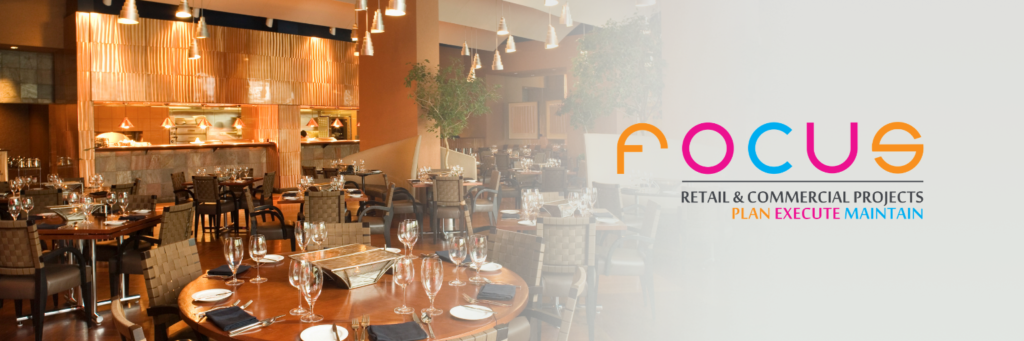
Melbourne's hospitality sector is one of the most competitive and design-conscious dining markets in Australia. Restaurant fitouts Melbourne operators commission need to achieve three things simultaneously: function as a compliant commercial kitchen capable of sustained high-volume service, create an atmosphere that customers return to, and hold up under the physical demands of daily trading across a five-to-ten-year tenancy. That is a more complex brief than it first appears, and most of the costly mistakes made in restaurant fitouts come from underestimating the weight of any one of those three requirements.
This guide covers what hospitality businesses should address when planning a restaurant or cafe fitout in Melbourne, from initial brief questions through to compliance, kitchen layout, front-of-house design, and the pre-opening checklist. For context on fitout investment, cost structure, and what affects the final price, the 2026 price guide for shop fitouts in Australia is a useful starting reference before engaging any contractor.
Starting with the right brief questions
A restaurant fitout brief needs to answer several specific operational questions before a drawing is produced. These questions shape every design decision that follows, and ambiguity at the brief stage is the most common reason fitouts require expensive variations during construction.
- What is the expected cover count at peak service, and what table configuration achieves it within the available floor plate while meeting egress requirements?
- Is the service model table service, counter service, or a combination, and how does that affect the relationship between the kitchen pass, service stations, and front-of-house circulation?
- What is the kitchen's maximum output in covers per service, and are the ventilation, gas, and electrical load provisions of the tenancy adequate for that volume?
- What ambience is the venue aiming for, and how do colour, materials, lighting, and acoustic treatment combine to create it? The psychology of colour in retail is a useful reference for understanding how colour choices affect customer behaviour and atmosphere in commercial hospitality environments.
- What is the anticipated trading life of the fitout, and which materials and finishes are specified to maintain their appearance under Melbourne's hospitality conditions across that period?
- What approvals does the project require, and what are the realistic timeframes for each? In Melbourne, planning permits, building permits, and food premises registration all have their own pathways and timeframes.
Commercial kitchen compliance in Victoria
The back-of-house is where compliance risk is highest in restaurant fitouts in Melbourne. The commercial kitchen must meet the requirements of Food Standards Australia New Zealand (FSANZ), the Food Act 1984 (Vic), and the standards enforced by the relevant council's environmental health officers. Failure to meet these requirements results in a failed food premises inspection, which prevents the venue from trading and requires rectification work before reinspection. Key compliance requirements for a Melbourne commercial kitchen include:
- Surface materials across walls, ceilings, and floors that are smooth, impervious, and cleanable to the standard required for food preparation areas under Australian Food Standards
- Separate handwashing facilities for kitchen staff at the kitchen entry, accessible without crossing food preparation areas, with warm running water and soap dispensing
- Refrigerated and dry storage with correct temperature control capabilities and physical separation of raw and ready-to-eat food items at every stage of the production flow
- Exhaust canopy specifications matched precisely to the cooking equipment load, with adequate make-up air supply to prevent negative pressure in the kitchen during service
- Grease trap sizing and installation location compliant with the relevant council's trade waste requirements, including accessible cleanout provisions
- Adequate lighting at all food preparation, storage, and cleaning areas to meet the minimum lux levels specified under food safety standards
Kitchen equipment selection and placement should be agreed with the chef before the fitout drawings are finalised, not after. The equipment layout determines the entire production flow, and changes to equipment placement after construction has begun are among the most expensive variations in hospitality fitout work.
Front of house: What creates atmosphere and drives return visits
In Melbourne's hospitality market, front-of-house design is examined by customers with high expectations and broad points of comparison. Three elements carry the most weight in determining whether a dining environment succeeds commercially.
Lighting
Warm, layered lighting distinguishes a memorable restaurant from a functional one. Task lighting for tables, ambient lighting for the room, and accent lighting for design features work together to create the atmosphere that converts a first visit into a regular. Tunable lighting systems that shift colour temperature across service periods, from bright daylight during lunch to warmer tones at dinner, are worth specifying. The complete guide to retail lighting solutions in Australia covers the specification principles that apply directly to hospitality design environments.
Acoustics
Hard surfaces, including polished concrete floors, exposed brick walls, and tiled finishes, are common in Melbourne's hospitality aesthetic but create challenging noise levels at full service capacity. The Acoustical Society of America has published research on how background noise levels in hospitality environments directly affect customer dwell time, conversation comfort, and satisfaction scores. Effective acoustic treatment in a restaurant fitout integrates architecturally, through ceiling baffles, upholstered booth seating, timber acoustic panels, and soft furnishings placed at intervals across the floor, rather than as an afterthought once the hard surfaces are already in place.
Joinery and material durability
Bar counters, host stations, booth seating, and display shelving all need to balance visual appeal with genuine durability under commercial trading conditions. Materials that photograph well but show wear within six months of opening undermine the venue's positioning in a market where customers share images and write detailed reviews. The specification standard should account for both the opening-day aesthetic and the two or three-year trading reality, because in Melbourne's hospitality market, a fitout that ages poorly is noticed.
Council approvals and permits in Melbourne
Restaurant fitouts in Melbourne almost always require both a planning permit and a building permit, particularly where a change of use is involved, structural alterations are proposed, or an alfresco dining area is being added. The permit process may also involve referral to Heritage Victoria where heritage overlays apply to the building or precinct. For a detailed comparison of how approval processes differ between Sydney and Melbourne, this guide to navigating council approvals covers the key differences. Starting the permit process early in the design phase, before construction documentation is complete, prevents weeks of unnecessary delay at the critical path.
Pre-opening checklist
Before trading begins, confirm all of the following are in order and documented:
- Food premises registration has been submitted to the relevant council environmental health team and a registration number has been received.
- Council inspection of the kitchen has been scheduled and passed, including compliance with FSANZ requirements and the Food Act 1984 (Vic).
- Electrical, plumbing, and gas certificates of compliance have been obtained from all licensed trades and filed with the lease documentation.
- Exhaust canopy performance has been tested under full cooking load and make-up air has been confirmed as adequate before service begins.
- An accessibility review confirms DDA-compliant entry, accessible amenities, and appropriate signage throughout, in line with Australian Human Rights Commission requirements for public premises.
- All outstanding defects from the practical completion inspection have been rectified and signed off before the first service.
Focus Shopfit brings experience across retail and hospitality commercial fitouts Melbourne to every project. To talk through your restaurant or cafe fitout with a team that understands both the compliance requirements and the design ambitions of the Melbourne market, get in touch here and start the conversation.
A guide to the design and compliance of pharmacy fitouts
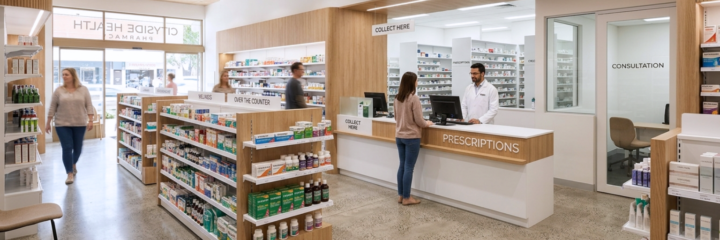
Pharmacy fitouts occupy a category of their own within commercial fitout work. They combine a strictly regulated dispensary environment with a retail consumer-facing space, and the design must serve both functions with equal care. A patient walking in wants a space that feels professional, calm, and easy to navigate. The dispensary team needs a layout that supports accuracy, efficiency, and full compliance with the legal requirements governing how controlled substances are stored and dispensed.
The challenge is that these two requirements pull in slightly different directions. Retail spaces benefit from openness, browsing-friendly layouts, and prominent product displays. Dispensary environments require controlled access, defined workflows, and secure storage. A well-designed pharmacy fitout resolves this tension rather than compromising either side of it. This guide covers the core elements of designing and delivering pharmacy fitouts in Australia, from the regulatory foundations through to retail pharmacy design, joinery specification, and pre-handover compliance. For an example of how these principles apply in practice, this look inside a high-end medical fitout in Perth illustrates the standard of finish and compliance detail that a capable fitout team delivers.

What the regulatory framework requires
Australian pharmacies are regulated at the state and territory level, but all operate under the professional standards set by the Pharmacy Board of Australia. Before any design work begins, the following requirements need to be incorporated into the fitout brief and confirmed with the client's pharmacist-in-charge and any relevant regulatory body:
- Physical separation of the dispensary from the retail floor, with access controlled to authorised staff. The configuration of this separation varies by state but must in all cases prevent customer access to dispensary areas.
- Secure storage for Schedule 8 controlled substances, complying with state regulations on safe specifications, security ratings, and installation requirements. Requirements vary between states and must be confirmed against the relevant legislation before specification.
- A private consultation area for patient counselling, soundproofed adequately for conversational privacy and accessible for patients with mobility impairments, including compliant door width and unobstructed floor space.
- DDA compliance across the premises: accessible aisles, a compliant service counter with a lowered section, and an accessible entry. The Australian Human Rights Commission sets out what DDA compliance requires for premises open to the public, and these requirements need to be confirmed against the specific building class and occupancy type during the design phase.
- State-specific premises requirements. In Western Australia, for example, the Pharmacy Act 2010 sets out conditions that must be met for a licence application or renewal, including specific provisions around the arrangement of dispensary areas and patient consultation facilities. Other states have equivalent frameworks that must be confirmed with the relevant pharmacy authority before the design is finalised.
- Adequate hand hygiene facilities for dispensary staff and, where clinical services are provided, in the consultation area. The location, specification, and number of hand hygiene stations may be subject to specific requirements under state health legislation.
Identifying these requirements at the design stage avoids the cost and disruption of redesigning elements after documentation has been prepared or construction has begun. The most expensive changes in any fitout are those required after documentation is locked or construction has started.
Dispensary layout and staff workflow
The dispensary is the operational core of any pharmacy. Its layout directly affects script throughput, dispensing accuracy, and staff fatigue levels across a full trading day. Poor ergonomic design in dispensary environments is a documented contributor to workplace injury, particularly musculoskeletal disorders affecting the wrists, shoulders, and lower back. Safe Work Australia identifies workstation design as one of the most effective controls for reducing musculoskeletal disorders in high-repetition work environments. An effective dispensary layout accounts for all of the following:
- A logical production flow from script receipt through dispensing, clinical check, and patient handover at the dispensary counter, with no crossing of pathways between clean and used medication handling areas
- Adequate bench space for labelling, packaging, and clinical verification, with ergonomic counter heights throughout the dispensary to reduce cumulative fatigue over a full shift
- Integration provisions for dispensing robots or automated dispensing units (ADUs) where relevant, including appropriate floor loading, power supply, data connection, and ventilation provisions sized for the specific unit being installed
- Clear separation of fast-moving and slow-moving medication storage, with the most frequently accessed products positioned for minimum reach and movement
- Clear sightlines from the dispensary to the retail floor and the front counter, allowing supervision of the retail area and visual queue management from the dispensing workstation
Retail pharmacy design: The customer-facing environment
The retail component is where brand identity, product range, and patient experience intersect. Retail pharmacy design involves considerably more than arranging shelving categories. It shapes how patients perceive the quality of care they receive and directly influences purchase behaviour across health, wellness, and OTC product categories. Key design decisions in the retail zone include:
- Category zoning that creates a logical patient journey from front-of-store impulse categories through to health and wellness zones positioned closer to the dispensary counter
- Gondola heights and shelving depths that balance product visibility and range presentation with accessibility for elderly patients and those with reduced reach or mobility
- Lighting design that supports clear product legibility, creates a professional and reassuring atmosphere, and minimises glare in consultation and waiting areas. The complete guide to retail lighting solutions in Australia covers the specification principles that apply directly to pharmacy retail environments.
- Colour and material choices that communicate trust, calm, and clinical professionalism. The psychology of colour in retail is particularly relevant in health environments where patient confidence is a central part of the brand proposition.
Joinery specification for pharmacy fitouts
Pharmacy joinery must meet durability, hygiene, and operational requirements simultaneously, which creates a more demanding specification brief than most retail fitout categories. Dispensing benches need to be specified for the cleaning agents and disinfection protocols used in the dispensary environment. Retail fixtures need to withstand daily restocking and customer browsing without showing premature wear. Consultation room joinery needs to balance privacy screening with a welcoming, non-clinical feel.
Where dispensing software hardware is integrated into benchtop design, the joinery specification requires input from the dispensing system provider to confirm correct placement, cable access, ergonomic height, and screen positioning. This coordination needs to happen during the design phase, not during installation.
Pre-handover compliance checklist
Before a pharmacy fitout is handed over and a premises licence application is submitted to the relevant state authority, confirm the following items have been addressed and documented:
- S8 controlled drug safe installed, compliant with the applicable state drug regulations, and a compliance certificate obtained
- Consultation room privacy, soundproofing, and DDA access provisions verified against applicable standards and confirmed with the pharmacist-in-charge
- DDA-compliant service counter with lowered section confirmed, accessible entry pathway confirmed clear and measured
- Dispensary access control limiting entry to authorised staff operational and confirmed with the responsible pharmacist
- Commercial fitout accessibility requirements confirmed against the NCC accessibility provisions for the relevant building class and occupancy
- Certificates of compliance from electrical, plumbing, and other licensed trades obtained, filed, and available for submission with the licence application

Pharmacy fitouts require a team familiar with both regulated commercial environments and quality construction delivery. If you are planning a new pharmacy fitout or a refurbishment of existing premises, speak with the Focus Shopfit team to discuss how the design and compliance requirements can be managed efficiently from brief through to handover.