
The design and construct (D&C) model is widely used across Australian shopfitting and commercial fitout, and for good reason. A single contractor takes responsibility for both design and delivery, which concentrates accountability, compresses the programme, and removes the coordination friction that causes disputes in traditional delivery models. The key characteristics of the model are these:
- A single contractor takes responsibility for both design and construction
- The client brief replaces a full set of architectural drawings as the starting point
- Design, pricing, and programme are developed together rather than in sequence
- Accountability for design errors and construction performance sits with one party
- Variations caused by design discrepancies are substantially reduced

What design and construct actually means
In a design and construct shopfitting engagement, the contractor carries both the design liability and the construction obligation, which concentrates accountability in one party and removes the coordination gaps that generate disputes and cost overruns in traditional delivery models.
In a traditional design-bid-build model, the client engages an architect or designer separately, develops a full set of drawings and specifications, then sends those documents to contractors for tender. The contractor prices what the drawings say. If the drawings are incomplete, the contractor qualifies the price. If the design does not work on site, the parties argue about who is responsible for the discrepancy.
The D&C shopfitting model removes this separation. The client engages a D&C shopfitter who takes the brief, develops the design to a level that satisfies council and landlord requirements, and commits to a fixed or negotiated price encompassing the full scope. From that point, the contractor owns the outcome.
The brief still needs to be thorough. Vague briefs lead to designs that miss the mark, and changes after design lock-in generate cost. The Australian Institute of Architects (AIA) provides guidance on what a thorough design and documentation phase involves, which gives useful context when comparing the depth of process offered by different D&C shopfitters.
How the process unfolds
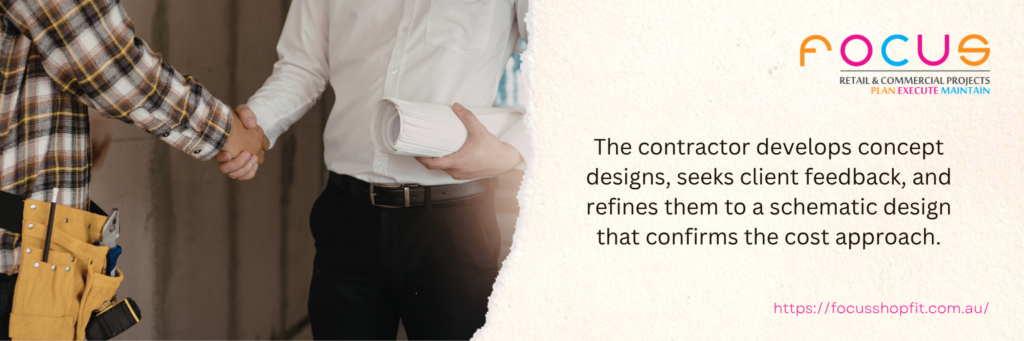
The client provides a brief covering the scope of works, any fixed requirements such as brand standards or landlord fitout guidelines, the budget range, and the required programme. The contractor develops concept designs, seeks client feedback, and refines them to a schematic design that confirms the cost approach.
Schematic design is then developed to design development, providing enough detail to submit to the landlord for approval and, where required, to council for development application (DA) or building permit. Once approvals are obtained, construction documentation is completed and the project moves to site. How the execution phase is structured and where accountability sits is worth reviewing before briefing any contractor.
During construction, the D&C contractor manages all trades, provides site supervision, coordinates inspections, and is responsible for delivering to the agreed scope, quality, and programme. Practical completion triggers handover, at which point the client takes possession and the defects liability period begins.
When D&C shopfitting is the right model
D&C suits business owners who have a clear concept of what they want but no time or inclination to manage a separate design process. National retailers with established brand standards who need consistent delivery across multiple sites are a strong D&C fit. Businesses where the scope is relatively well defined, such as a pharmacy, a dental clinic, or a food retail outlet in a standard tenancy, also benefit from the single-point accountability structure.
D&C is less suited to highly complex architectural projects where the design itself is a significant part of the brief and the client wants direct input at every stage. In those cases, engaging an independent architect for design and a contractor for construction can give more design control, at the cost of a more complex delivery structure.
Understanding what professional project management actually delivers within a D&C engagement is worth clarifying with any contractor on your shortlist. What a properly run retail fitout project management process looks like covers the key questions to ask when evaluating any contractor’s approach.
Risks and how to manage them
The D&C model transfers design risk to the contractor. This is an advantage when the contractor is experienced and genuinely capable in design. A D&C shopfitter that is competent in construction but weak in design can produce a technically compliant fitout that performs poorly commercially or creates operational inefficiencies that only become apparent after opening.
Due diligence before engaging a D&C shopfitter should include reviewing a portfolio of completed projects in your sector, speaking with previous clients about the design process specifically, and assessing whether the contractor has genuine in-house design capability.
A clearly drafted D&C contract that specifies the client brief, confirms the design approval process, identifies the conditions for variations, and sets out programme obligations reduces the risk of disputes. Working through a structured fitout scope checklist before engaging any contractor ensures the scope is well defined before any agreement is signed.
The D&C model at Focus Shopfit
Focus Shopfit has operated as a design and construct shopfitter since 1984. Our model integrates in-house design, trade management, and project delivery under a single commercial relationship. The planning phase is where the client brief is translated into a design, budget, and programme that the delivery team can execute with confidence.
Operating from Perth and Auburn, we deliver D&C fitout projects nationally across retail, hospitality, commercial, and healthcare sectors. Post-handover, our Maintain service supports the fitout investment over its full trading life.
For context on what the full project lifecycle looks like from brief to opening day, a realistic breakdown of each fitout phase and how long each takes walks through the phases with realistic timeframes.
Focus Shopfit has been delivering D&C fitout projects across Australia since 1984. If you are weighing up whether D&C is the right model for your project, get in touch with our team to talk it through before you commit to any engagement structure.