
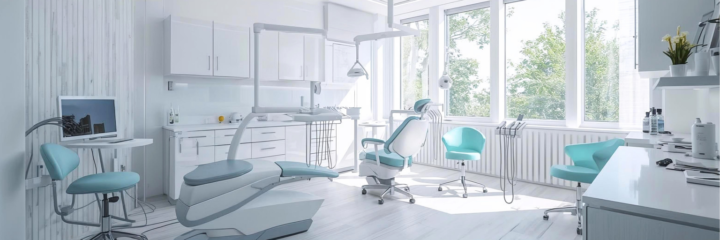
How to design a dental fitout in Perth that meets compliance and patient needs
Dental fitouts are among the most technically demanding projects in the commercial fitout industry. Every design decision has compliance implications. In Perth, the regulatory environment adds Western Australia (WA)-specific requirements to national standards, and demand for new dental premises in the metro area has grown with population expansion in the northern and southern corridors.
The decisions covered below are the ones that most directly determine project cost, compliance outcome, and patient experience. They need to be made before construction begins, not during it.
The core challenge: Compliance and experience working together
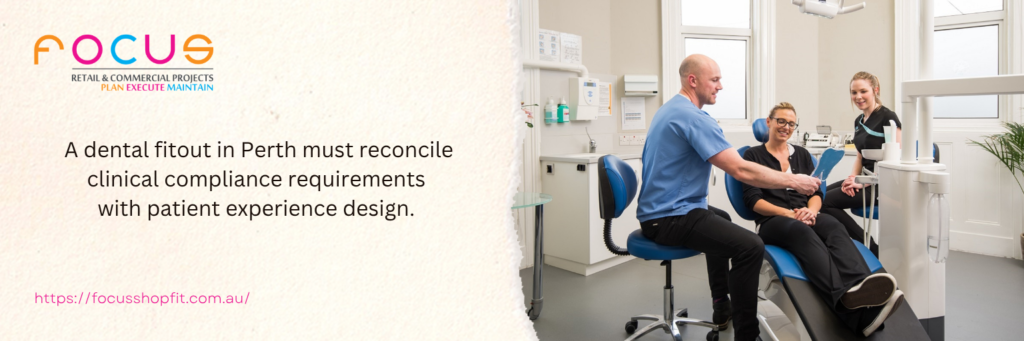
A dental fitout in Perth must reconcile clinical compliance requirements with patient experience design, and the practices that do this well consistently outperform those that treat the two as separate problems to be solved by different teams at different stages.
Practices that separate these priorities produce fitouts that underperform on at least one dimension. The spatial planning that satisfies infection control standards can also create a clear patient journey. The material selection that meets sterilisation-grade requirements can also communicate cleanliness and calm to anxious patients. Getting this right requires a fitout team that understands both dimensions from the brief stage.
For a benchmark of what a high-specification healthcare fitout looks like when these priorities are resolved well, a walkthrough of a completed high-end medical fitout in Perth illustrates the standard of finish and compliance detail that a capable fitout team delivers.
Clinical zone planning
- Treatment room configuration
Treatment rooms in a dental fitout require minimum clear floor areas that allow a dentist, assistant, and patient chair to operate without obstruction. A practical minimum is 11 to 14 square metres per operatory, depending on whether a dedicated cabinetry wall, mobile delivery unit, or built-in dental unit is specified. Room orientation affects operability; natural light is desirable for patient comfort but creates glare conflicts with the operating light. Where possible, position the patient chair with a north or east aspect to allow natural light without direct sun exposure during treatment hours.
- Infection control zoning
Australian Standard (AS)/NZS 4187 governs reprocessing requirements for reusable medical devices in healthcare settings. For dental fitouts, the sterilisation area must be designed as a defined zone with unidirectional workflow: contaminated instruments enter on one side, and clean and sterile instruments exit on the other. Cross-contamination between dirty and clean zones is a compliance failure. The sterilisation room should be physically separated from treatment areas by at least a wall and door, and air flow direction should move from clean to contaminated zones.
- Staff circulation and cross-contamination prevention
Staff movement between treatment rooms and support areas must be planned to prevent contaminated materials from passing through clean spaces. For practices with four or more operatories, a staff corridor that is separate from patient-facing areas is worth the additional floor area. This affects the location of the sterilisation room, waste disposal points in each treatment room, and the design of the reception-to-clinical boundary.
Infrastructure requirements
- Dental services and gas
Each treatment room requires a compressed air supply at a minimum of 700 kPa at point of use, suction systems covering high-volume evacuation and saliva ejector, medical-grade gases if nitrous oxide (N2O) is used, and water supply for the dental unit. The technical routing of these services through the floor and wall structure must be confirmed before construction begins. Amalgam separator requirements apply in WA under environmental protection regulations, and new fitouts should include amalgam separation in the drainage specification from the start.
- Electrical and data infrastructure
Modern dental equipment is data-intensive. Digital radiography units, intraoral cameras, patient management systems, and practice software all require structured data cabling and reliable power supply. Over-specifying data and power points at the construction stage is significantly cheaper than retrofitting after handover. X-ray room design requires radiation shielding assessment; under WA's Radiation Safety Act 1975, dental radiography equipment requires Radiological Council of WA approval and a shielding design signed off by a qualified radiation physicist before construction begins.
- HVAC and air quality
Dental procedures generate aerosols that present an infection control risk. Heating, ventilation, and air conditioning (HVAC) design for a dental fitout should include air filtration appropriate for clinical environments and ensure air is not recirculated between treatment rooms. Ventilation requirements for healthcare-classified spaces are governed by the NCC provisions published on the Australian Building Codes Board (ABCB) portal, which is the authoritative reference for compliance.
Patient experience design
- Reception and waiting areas
The reception and waiting area is the patient's first physical experience of the practice. Design decisions here communicate positioning, cleanliness, and approachability before any clinical interaction occurs. Key considerations include:
- Reception counter design: a lowered section for wheelchair users is both accessible and more welcoming than a uniformly elevated counter
- Acoustic separation: dental procedure sounds should not be clearly audible in the waiting area
- Seating materials: cleanable, visually comfortable, and without appearing clinical or institutional
- Lighting: warm white tones in waiting areas contrast deliberately with the cooler, brighter lighting in treatment rooms, reinforcing the psychological transition between comfort and procedure
- Patient anxiety and environmental design
Dental anxiety affects a significant proportion of adult patients. Fitout design that reduces visible clinical cues in patient-facing areas, minimises noise transfer, and creates a calm, navigable environment contributes directly to patient retention and referral behaviour. The same principles that drive purchasing behaviour in retail, covered in depth in this analysis of how colour choices affect customer psychology, apply with direct relevance to the patient-facing zones of a dental practice.
Regulatory and compliance requirements in Perth
Commercial building works in WA require approval under the Building Act 2011. For dental premises, this typically means a building permit is required, and a building surveyor must certify compliance with the NCC and relevant Australian standards. Healthcare premises may also trigger referral to the WA Department of Health for premises approval under the Health (Miscellaneous Provisions) Act. Building certification requires documentation of fire safety compliance, accessible design under AS 1428, and electrical safety certification.
The Australian Human Rights Commission (AHRC) sets out what Disability Discrimination Act (DDA) compliance requires for premises open to the public. Accessibility requirements must be confirmed against the specific building class and occupancy type during the design phase.
Budget considerations
Dental fitout costs in Perth typically range from $2,500 to $5,000 per square metre for a standard 100 to 200 square metre tenancy. Radiation shielding, amalgam separation, compressed air systems, and specialist dental cabinetry are costs that do not appear in a standard commercial fitout and are frequently underestimated in early budgets. Working through a structured fitout scope checklist before engaging contractors is a practical way to surface these items before quotes are sought.
Focus Shopfit has been delivering healthcare fitouts nationally since 1984. To discuss your dental fitout in Perth or elsewhere in WA with a team experienced in clinical compliance and commercial delivery, reach out here and start the conversation.


A look inside a high-end medical fitouts in Perth
A high-end clinic is more than a polished reception desk and a clean colour palette. The best spaces feel calm, intuitive, and efficient for both patients and staff, even when the schedule is packed.
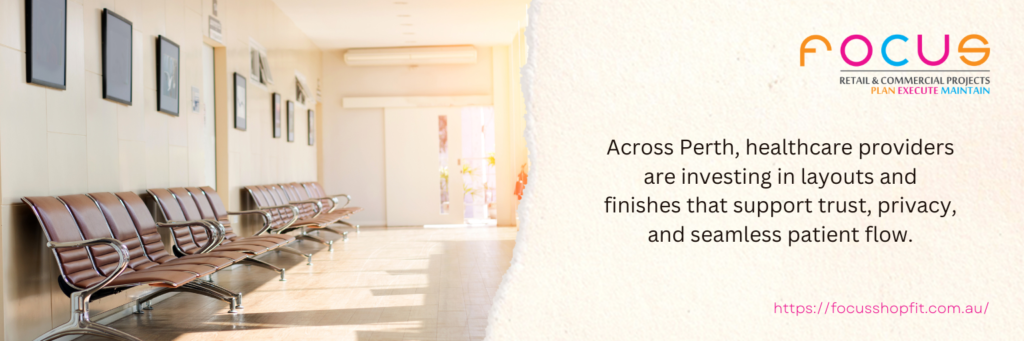
Across Perth, healthcare providers are investing in layouts and finishes that support trust, privacy, and seamless patient flow. These details are what set premium medical fitouts in Perth businesses commission apart from basic refurbishments.
This guide walks through what you would typically find inside a well-executed clinic fitout, plus the planning choices that make the space work in day-to-day operations. It is designed to be practical, so you can use it when briefing your designer, builder, or landlord.

What makes a medical fitout feel high-end
Luxury in a clinic is not about being flashy. It is about creating a space that feels safe, quiet, and well-managed. Patients notice simple signals like a clear check-in area, comfortable lighting, and privacy at the front desk. Staff notice different signals, such as storage that is actually accessible, consult rooms that support workflow, and back-of-house zones that prevent congestion. Great healthcare design often looks effortless because the hard thinking happened during clinical fitout planning.
Zoning that protects privacy and keeps flow efficient
One of the biggest differences between average and premium fitouts is zoning. A high-end clinic is typically organised around a simple question. What should a patient see, hear, and experience at each step of their visit? A strong zoning plan usually separates public areas from clinical areas and staff-only routes. That can include a reception and waiting space designed to reduce crowding, consultation rooms that feel private, and staff movement paths that do not cut through patient zones.
If you are designing for multiple services, zoning also supports clearer wayfinding. It helps patients arrive at the right room without feeling lost, rushed, or exposed.
Reception design that balances welcome and confidentiality
Reception is often the most emotionally loaded part of the clinic experience. People may arrive anxious, unwell, or time poor. A premium reception zone reduces friction from the first interaction. This can involve a check-in point that avoids direct eye contact with the waiting area, acoustic treatments that soften voices, and seating layouts that reduce face-to-face crowding. In terms of finishes, premium clinics often prefer durable surfaces that still feel warm, such as textured laminates, engineered stone, and joinery details that avoid a sterile look while remaining easy to maintain.
Consult rooms designed around real clinical tasks
A consult room should support the work, not force the clinician to adapt. High-end clinics design each room around the procedures and equipment used daily, then refine the details for patient comfort. This is where clinical fitout planning becomes a cost saver. When power points, sink locations, equipment storage, and staff circulation are mapped early, you reduce rework and protect your programme.
Many providers also choose consistent room layouts across consult rooms. This supports staff training, reduces errors, and makes supplies easier to manage.
Lighting that supports comfort and clinical accuracy
Lighting is a major part of patient comfort and clinical visibility. Premium medical fitouts in Perth clinics typically use layered lighting so each space can shift between calm ambience and practical task clarity. That may include softer ambient lighting in waiting areas, focused task lighting in treatment rooms, and glare control near mirrors and glossy surfaces.
For broader guidance on safe and functional health facility layouts, the Australasian Health Facility Guidelines are a useful reference for room planning and healthcare project considerations.
Finishes that look premium and stay practical
In healthcare, finishes must handle cleaning, traffic, and wear. The premium difference comes down to choosing materials that perform under pressure while still looking refined. Common upgrades include more resilient flooring transitions, wall protection in high-contact zones, and joinery detailing that hides gaps where dust collects.
If you are weighing finish tiers and how they affect your project budget, this 2026 shopfit cost guide is a helpful benchmark for comparing outcomes across different investment levels.
Back-of-house spaces that protect staff time
High-end clinics often invest more in areas patients never see, because that is where staff efficiency is won or lost. Storage, staff rooms, clean utility areas, and admin zones reduce bottlenecks and support consistent service delivery.
A well-designed storage wall, for example, can remove dozens of small interruptions across a day. It also improves inventory control and reduces visible clutter in consult rooms. This level of detail is easiest to deliver when the site is managed as a coordinated project. Focus Shopfit’s team takes a structured approach to project-managed fitout delivery, so clinical layouts and services coordination stay aligned during installation.
Compliance and accessibility planned from the start
Premium outcomes come from fewer late changes. Accessibility, fire safety scope, and service requirements should be addressed early, particularly where tenancy conditions or centre rules may affect the build.
For businesses that want to understand the documentation that usually sits alongside commercial works, the overview on permits, zoning, and approvals provides a plain-English snapshot of common triggers.
A premium patient experience is built in small moments
The final difference comes down to touchpoints. It is the quiet waiting area layout, the well-placed signage, the door hardware that feels solid, and the acoustics that stop consult conversations travelling. In modern healthcare design, these choices support brand trust just as much as clinical capability. Patients may not describe every detail, but they feel the difference immediately.
When you approach medical fitouts in Perth clinics commission with a patient-led lens and a staff-led workflow plan, you create a space that performs over time, not just on opening day.
If you are planning a new clinic or upgrading an existing space, Focus Shopfit can help you translate your service model into a buildable fitout plan. Get in touch via the contact page to discuss timelines, scope, and the level of finish that suits your brand.