When planning a commercial fitout Australia, it is easy to get swept up in the aesthetics of design. But beyond the colours and finishes lies a critical, non-negotiable aspect: accessibility. Creating a space that is welcoming and usable for every person, regardless of their physical abilities, is both an ethical responsibility and a legal requirement.
Understanding the relevant shopfitting regulations can seem daunting, but it is an essential part of your responsibility as a business owner. This guide will provide an overview of accessibility in design, helping you ensure your new fitout is inclusive and compliant from day one.

What is accessibility compliance in Australia?
In Australia, accessibility is primarily governed by the Disability Discrimination Act 1992 (DDA). This federal law makes it illegal to discriminate against a person on the grounds of disability. For a retail or commercial space, this means you must provide equal access to your premises, goods, and services.
The technical standards for achieving this are outlined in the National Construction Code (NCC) and various Australian Standards, such as AS 1428.1. These documents specify the minimum requirements for features like ramp gradients, doorway widths, and accessible bathroom layouts. A professional commercial fitout specialist in Australia will be well-versed in these standards.
Key areas of focus for accessibility in design
When planning your fitout, here are the critical areas you and your shopfitter must address to ensure compliance.
- Accessible entry and exit: Your main entrance must be accessible. This means having at least one entrance with no steps or providing a compliant ramp or lift. Doors must be wide enough to accommodate wheelchairs and have appropriate handles.
- Clear paths of travel: Customers need to be able to move freely through your store. Main thoroughfares should be wide enough for a wheelchair to pass through and turn around. Keep these paths clear of temporary displays or clutter.
- Point of sale (POS) and service counters: Your checkout counter must have a lower section to comfortably serve customers in wheelchairs. It should be clearly identifiable and easy to approach. This is a key detail in shopfitting regulations.
- Accessible amenities: If you have public restrooms, you must provide at least one accessible unisex toilet that meets the specific dimensional and fixture requirements of the Australian Standards.
- Signage: Signage should be easy to read, positioned at an appropriate height, and use clear, contrasting colours. For key facilities like restrooms, consider including braille and tactile elements.
Why accessibility is more than a legal box to tick
While compliance is mandatory, true accessibility in design also offers significant business benefits.
- It expands your customer base: Approximately 1 in 5 Australians has some form of disability. By creating an accessible space, you are welcoming a significant portion of the population that may otherwise be unable to shop with you.
- It improves the customer experience for everyone: Features designed for accessibility, such as wider aisles and clear signage, benefit all shoppers, including parents with strollers and the elderly.
- It enhances your brand reputation: An inclusive and welcoming business is one that customers respect and want to support. It shows that you care about your community.
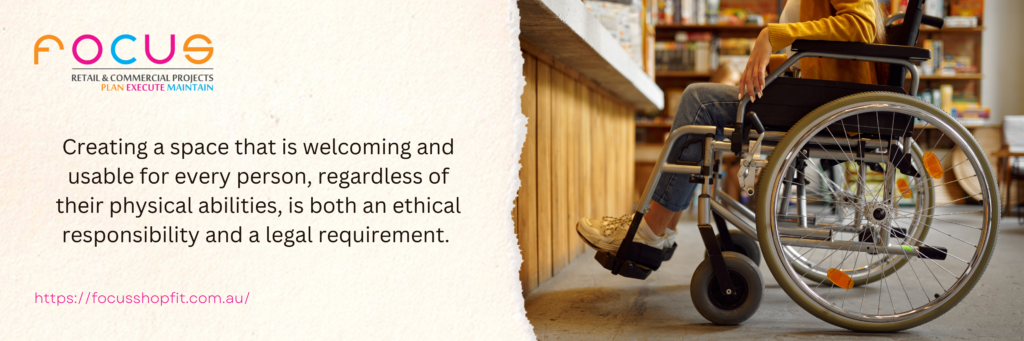
Planning an inclusive commercial fitout in Australia is a collaborative effort between you and your project team. By making it a priority from the very beginning, you can create a space that is not only beautiful and functional but also truly welcoming to everyone. We explore this further in our blog on shopfitting for staff workflow and reducing injury risk.
Inspired to create something amazing? Seeing what’s possible is the first step. At Focus Shopfit, we’ve helped businesses across Australia create stunning and compliant environments that drive sales and enhance customer experience. To discuss how we can bring your vision to life, contact us today.