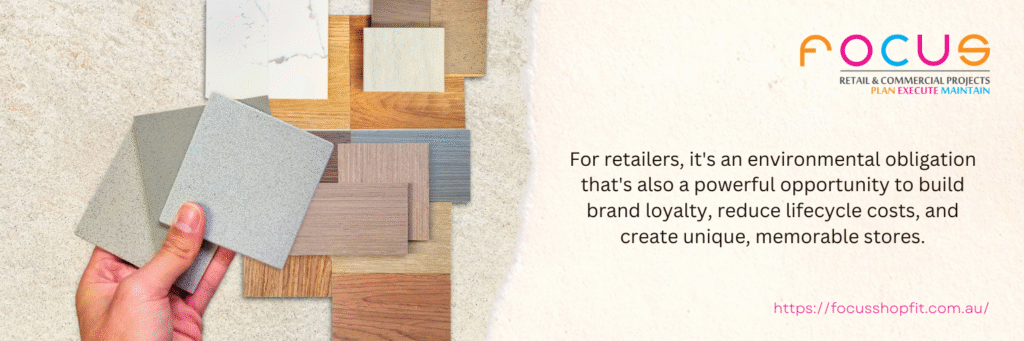
The Australian retail sector is reaching a tipping point. The traditional “take, make, dispose” model is rapidly becoming obsolete, replaced by the imperative of the circular economy. For retailers, it’s an environmental obligation that’s also a powerful opportunity to build brand loyalty, reduce lifecycle costs, and create unique, memorable stores.
In the face of Australia’s national goal to double its circularity rate by 2035, the decision of which materials to use in your next retail fitout is now central to business strategy. The key lies in deliberately sourcing locally, closing material loops, and designing for a long, adaptable life.
- Embracing Australian reclaimed and recycled materials
Moving to a circular economy means maximising the lifespan and utility of every resource. For shopfitters, this translates into a deliberate shift away from virgin materials towards those that already possess a rich local history.
- Reclaimed timber: Few materials offer the same warmth and authentic Australian character as reclaimed timber. Sourcing planks from decommissioned woolsheds, old wharves, or demolition sites provides incredibly durable wood—like Spotted Gum or Blackbutt—that reduces demand on new forestry. This material can be used for flooring, feature walls, or joinery, giving your space a unique story customers will appreciate.
- Recycled aggregates and plastics: Australian innovation is transforming waste streams into high-quality building products. Look for countertops made from recycled glass and concrete aggregate, or floor coverings made from upcycled ocean plastic or textile waste. These materials often have lower embodied carbon and a unique aesthetic appeal that immediately communicates your brand’s commitment to sustainability.
Tip: Work with Australian suppliers who provide clear provenance documentation. Telling the story of where your recycled timber came from builds an immediate connection with the local, conscious consumer.
- The power of Design for Disassembly (DfD)
The ultimate failure of the linear economy in retail is the massive waste generated during a store strip-out. A truly circular retail fitout must be designed to be deconstructed, not demolished. This strategy is known as Design for Disassembly (DfD).
- Modular fixtures: Replace permanent, custom-built walls and shelves with modular retail shelving systems. These fixtures use mechanical fixings (screws and brackets) rather than permanent adhesives or stud walls, allowing them to be quickly dismantled, reconfigured, or moved to a new site without destruction. This dramatically increases the longevity of your assets and drastically reduces construction and demolition waste.
- Material separation: Ensure that different materials are easily separable. For example, fixtures should not be laminated with complex, hard-to-recycle films, and different components (wood, metal, glass) should be fixed with screws, not glue. This prepares every component for its next life, whether that’s being recycled back into raw material or reused in another store.
- Sustainable sourcing for healthy interiors
The circular economy seeks to address where materials end up while ensuring they are healthy for the people who use the space. Australian consumers are becoming increasingly aware of volatile organic compounds (VOCs) and indoor air quality.
- Low-VOC paints and finishes: Specify paints, adhesives, and sealants with low or zero VOC content. This simple step vastly improves the air quality for your staff and customers, aligning with the “healthier environment” goals of the circular economy. Australian-made brands often offer excellent low-VOC ranges designed for local compliance.
- Local supply chains: Prioritise working with local Australian manufacturers for all joinery and furniture. Sourcing materials from within your state or country significantly reduces the embodied carbon associated with transport and supports the domestic economy, making your supply chain more resilient and transparent.
The future of Australian commerce demands retail spaces that are inherently sustainable. By integrating locally sourced reclaimed materials, adopting Design for Disassembly principles, and prioritising indoor air quality, your brand can move beyond simple sustainability talk and fully embrace the circular economy. This approach not only protects our environment but provides a clear competitive edge in a market that values authenticity and ethical practice.
At Focus Shopfit, we partner with ambitious businesses to create spaces that aren’t just built for today but designed for a sustainable tomorrow. Contact Focus Shopfit to learn more.