
The expectations placed on modern workplaces have shifted considerably. Hybrid working patterns, staff wellbeing, brand culture, and technology infrastructure have all become design requirements that office fitouts in Perth must address. Perth businesses investing in commercial office space today expect their fitout to actively support the way their teams work, not simply provide a fixed number of desks in a floor plan.
This guide covers the key elements that define a high-performing modern office fitout across design, acoustics, technology, compliance, and long-term flexibility. Each element is worth considering independently, but they deliver the best outcomes when planned together from the earliest stages of the brief.
Zoning and spatial variety
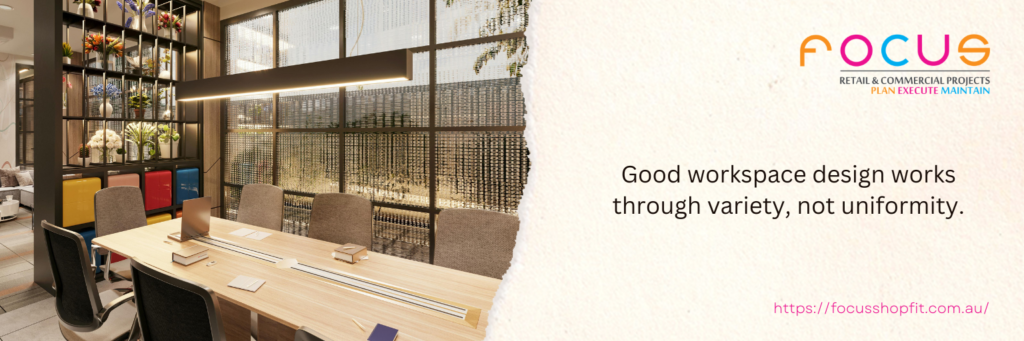
Good workspace design works through variety, not uniformity. A well-zoned office gives people genuine choices about how and where they work throughout the day, which has a measurable effect on output and satisfaction. The WELL Building Standard, which benchmarks commercial environments against health and productivity criteria, identifies spatial variety as a core factor in staff performance. A functional office fitout should include at least four distinct zone types:
- Focus zones: quiet areas for concentrated individual work, either fully enclosed or semi-enclosed to reduce acoustic intrusion from the surrounding floor
- Collaboration zones: open or semi-open areas configured for team discussion, ideation, whiteboard sessions, or informal stand-up meetings
- Breakout and social spaces: areas with a clearly different atmosphere from the primary work floor, giving staff a genuine mental transition away from desk-based work during breaks
- Formal meeting rooms: enclosed, bookable, and equipped with appropriate AV infrastructure for internal planning and external client meetings
Even in compact tenancies, clear spatial zoning creates a sense of variety and supports the range of working styles present across any team. The key is ensuring each zone is genuinely differentiated in its acoustic properties, its furniture configuration, and its visual character, rather than simply labelled differently on a floor plan.
Acoustic management
Open-plan offices are frequently cited by staff as the primary source of dissatisfaction with their working environment, and noise is consistently the leading complaint. Perth commercial builders working on office fitouts need to treat acoustics as a design requirement from the outset, not a retrofit problem to be solved after occupancy. Research from the Acoustical Society of America consistently identifies unwanted speech as the leading environmental complaint in open workplaces, with measurable negative effects on concentration and task accuracy. Effective acoustic management in an office fitout typically includes:
- Ceiling baffles and suspended acoustic panels that reduce reverberation across the floor plate, particularly important in tenancies with exposed concrete ceilings or polished floors
- Soft furnishings, including upholstered seating, area rugs, and fabric-faced partitions that absorb mid-frequency noise in breakout and collaboration areas
- Glazed or acoustic-rated partitions around focus zones and phone rooms, containing noise without fully enclosing the space and maintaining visual connection across the floor. The retail lighting and sensory design guide covers related principles for managing the full sensory environment in commercial fitouts, which apply equally in office settings.
- Strategic placement of high-traffic areas, including kitchen and breakout facilities, printer stations, and informal social zones away from focus work areas and close-concentration zones
- Sound masking systems in larger open-plan floors, which raise the ambient noise floor to a consistent level and reduce the intelligibility of distant conversations without making the environment feel louder
Lighting for productivity and wellbeing
Perth’s climate gives most commercial tenancies access to strong natural light for much of the year. Managing glare and solar heat gain while maintaining the connection to daylight requires deliberate specification choices. A layered approach to office lighting produces the best outcomes:
- Task lighting at workstations, individually adjustable to suit different working styles and the changing ambient conditions throughout the day
- Ambient lighting creates a consistent background level across the floor without harsh glare or shadow at desk level. For a broader context on commercial lighting specification, this guide to retail lighting solutions in Australia covers the principles that translate directly into office environments.
- Tunable LED systems that shift colour temperature across the day, supporting circadian health by providing cooler, more energising light in the morning and warmer, lower-intensity light in the afternoon
- Localised lighting in meeting rooms and collaboration zones on dimmable circuits, adjustable to suit the type of activity taking place from focused review sessions to informal social interactions
Technology and data infrastructure
Technology infrastructure for office fitouts in Perth must be planned from the earliest design stage. Adding infrastructure after construction is completed is consistently more expensive and more disruptive than building it in from the start. Key infrastructure decisions that need to be resolved before construction begins include:
- Structured cabling with adequate data points distributed across the floor plate, including at collaborative zones and informal work areas, not only at fixed desk positions
- Wireless access point placement agreed with the client’s IT team during the design phase, with conduit and cable pathways coordinated in the ceiling before any finishes are applied
- AV infrastructure in meeting rooms: screens, ceiling microphone arrays, and appropriate cable management for reliable hybrid conferencing across multiple time zones
- Power and USB access at breakout seating and collaboration tables, where flexibility of connection is increasingly expected as a baseline, not a premium feature
- Server and communications room provisions where required, including adequate ventilation, secure access, and appropriate power supply with backup provisions
Joinery, finishes, and brand expression
The visual quality of an office fitout communicates brand values to staff and visitors from the moment they enter. Custom joinery, including reception desks, storage systems, and breakout cabinetry, is where quality is most immediately visible and where the difference between a considered fitout and a generic one is most apparent. The role of custom joinery in Perth commercial fitouts covers how material selection and joinery specification shape the finished result. The key considerations when specifying joinery for an office fitout are durability matched to actual use patterns, brand integration that feels considered rather than applied as decoration, and lead times that are accounted for in the construction programme. Custom joinery typically takes four to eight weeks to manufacture, which is one reason why early engagement with the fitout team produces direct benefits in programme management.
Compliance and future-proofing
Office fitouts Perth must meet the National Construction Code (NCC) and relevant Australian Standards, including Disability Discrimination Act provisions for accessible pathways, compliant service counter heights, and egress requirements. A fitout team familiar with the local approval process will incorporate these requirements during the design phase, where they are straightforward to address, rather than under a compliance notice after occupancy, where they become expensive and disruptive to rectify.
A fitout designed only for current conditions will cost more to adapt than one built with flexibility from the outset. Features that improve the longevity of an office investment include demountable partitioning systems, modular furniture with reconfiguration options, and accessible cabling infrastructure that can be extended or rerouted without major construction. This is particularly relevant for businesses in growth phases, where team size and structure may shift significantly within the first three years of a lease term.
Focus Shopfit’s planning service covers design, joinery manufacture, and value engineering across office fitout projects throughout Perth and the broader Western Australian market. To discuss your office fitout with a team that understands workspace design and local compliance requirements, start the conversation here.