
Designing for dwell time: Creating a 'cool zone' retreat in hot Australian summer stores
The Australian summer is a brilliant time for retail, but the soaring temperatures and punishing sun present a unique challenge: how do you get customers off the bitumen and keep them browsing, not bolting? The answer lies in transforming your retail space from a mere point of transaction into a genuine "cool zone" retreat. This strategy, driven by intelligent shopfitting and design, is crucial for increasing dwell time and boosting sales in the heat.
Forget fighting the heat. Your design needs to offer an escape. By focusing on sensory merchandising and smart thermal management, you can create a desirable micro-climate that makes customers want to stay, linger, and ultimately spend.
The sensory oasis: Cooling the customer from the inside out
Effective retail design in a hot climate goes beyond the air conditioner. Leveraging sensory cues to make the customer feel cooler and more relaxed the moment they step inside is key.
- Visual cooling: Use light, reflective colours and materials. White, cool blues, and pale greens visually signal freshness and coolness. Feature high-gloss, sleek surfaces like polished concrete or light timber floors, which feel less heavy and heat-absorbing than dark carpet. Your shopfitter should prioritise light fixtures that mimic natural, bright light without the heat output, such as high-CRI LED retail track lighting.
- Aural calm: Replace fast-paced, high-energy music with softer, lower-tempo tracks. Ambient sounds or music with a coastal or natural theme can subconsciously drop a customer's heart rate, making the environment feel less frantic and hot.
- Olfactory freshness: Introduce subtle, non-overpowering scents. Avoid heavy vanilla or spice fragrances often used in winter. Instead, opt for light, fresh, and slightly citrus or minty aromas, which are psychologically linked to cleanliness and cool air.
Tip: Near the entrance, set up a small, temporary water display (like a water feature or simply a well-merchandised cooler of bottled water) with a gentle, running sound to enhance the sensation of immediate relief.
Micro-zoning for thermal comfort
Not every part of your store needs to be Antarctic cold. Smart shopfitting and design uses micro-zoning to create specific, targeted areas of comfort that encourage longer stays in high-value zones. Identify a mid-store lounge area—perhaps near fitting rooms or product demonstration zones—and designate it as the primary cool zone. By creating this intentional decompression area where customers can pause and reset, you are giving them a reason to stay in your store longer, which directly correlates to a higher likelihood of purchase.
Here, you can strategically augment the cooling experience:
- Fans and airflow: Use well-placed, quiet ceiling or pedestal fans to create a noticeable, gentle breeze. Even if the temperature is stable, increased air movement makes customers feel 2-3 degrees cooler.
- Comfort seating: Install comfortable, wide seating in materials that don’t retain heat, such as rattan or light canvas. Offer power points for phone charging—a powerful incentive to increase dwell time.
- Hydration stations: Partner with a local beverage supplier or café to offer complimentary (or low-cost) chilled water or small, icy treats. This simple hospitality act immediately improves the shopping experience.
Preventing the heat trap of display materials and placement
In the height of summer, traditional displays can become literally hot to the touch, deterring interaction.
- Material selection: Avoid dark metals or thick glass near sunny windows. Use modular retail shelving built from lighter materials that won’t absorb and radiate heat.
- Window shading: Implement adjustable shading solutions, like internal sheer blinds or retractable awnings, to block the harsh afternoon sun without sacrificing natural light. Your retail design should use the window for attraction, but not as a source of uncomfortable radiant heat inside the store.
- Product protection: Rotate stock away from direct sun exposure to prevent colours from fading and protect sensitive items (like cosmetics or food) from damage.
By designing your space to actively counteract the harsh Australian summer, you convert a potential barrier (the heat) into a competitive advantage, establishing your store as the comfortable, refreshing retail haven in the neighbourhood. Contact Focus Shopfit to find out more about how we can help you maximise dwell time for your store through flexible shopfitting.

Fire safety and festive crowds: Compliance checks your Australian shopfitter must complete before December
The Australian Christmas shopping rush brings two things in equal measure: massive sales opportunities and significant risk. With foot traffic surging through November and December, the risk of fire and crowd-related incidents skyrockets. Before you hang the last of the decorations, your shopfitter must complete a rigorous compliance audit to ensure your store is not only ready to sell but is legally safe.
Ignoring fire and safety regulations in a high-density period isn't just a compliance issue; it’s a threat to staff, customers, and your entire business. Here are the essential fire safety and crowd management checks your retail fitout must pass before the December peak.
Exit path clearance and access
In the frenzy of restocking and visual merchandising, it’s easy for boxes, display units, and seasonal signage to creep into exit routes. This is a massive compliance fail. Your shopfitter must verify that all designated paths of travel to fire exits are completely clear and maintained at their minimum required width, as stipulated by the Building Code of Australia (BCA).
A common hazard is the use of temporary floor displays, often placed to maximise impulse sales. While these are profitable, they must not obstruct the direct route to the nearest exit. All fire exit doors must be fully operational, easy to open, and not locked, chained, or obscured by festive decorations or bulky stock. This is non-negotiable for retail fire safety.
Tip: Use floor markings or brightly coloured tape to define the minimum clear width of your fire exit pathways. Train all staff to immediately remove any stock or fixtures encroaching on this zone.
Display material fire rating
Your stunning Christmas displays—from fabric backdrops and large foam props to synthetic garlands—could be a significant fire hazard if they aren't properly rated. In Australia, many regulations require that materials used in high-traffic commercial spaces meet specific flammability standards.
Before decorating, insist that your shopfitter provides certificates proving that major decorative materials, particularly those near lights or heat sources, are flame-retardant or non-combustible. Placing highly flammable materials near electrical Christmas lights or heat vents is an unnecessary risk that can quickly lead to a disaster, compromising your commitment to retail fire safety.
Tip: Opt for natural materials like wood and metal over large amounts of paper or synthetic fabrics. If you must use fabric, treat it with a certified fire-retardant spray and keep it away from all electrical sources.
Electrical load and appliance safety
Christmas lights, digital screens, extended operating hours, and temporary POS stations all put an enormous strain on your store's existing electrical infrastructure. An overloaded circuit is a common cause of electrical fires, and this is a key compliance check your shopfitter must oversee.
Before December, they should:
- Ensure all temporary wiring for lights and displays is secured and not running under carpets or across pathways where it could be damaged or tripped over.
- Verify that power boards and extension leads are not overloaded. No piggybacking.
- Confirm that all electrical appliances, including string lights and feature displays, have the required Australian regulatory compliance mark (RCM).
A full electrical safety audit should be considered an essential part of your pre-December preparation, ensuring maximum fire safety compliance.
Visibility and accessibility of fire equipment
When the store is packed with shoppers and seasonal displays, it’s easy for fire extinguishers, fire hose reels, and alarm call points to become hidden. Your fitout plan must ensure that all essential firefighting equipment is clearly visible, easily accessible, and clearly signed.
Make sure nothing is stacked in front of or hanging over your extinguishers. All staff must be trained in the location and correct use of this equipment, especially the temporary seasonal hires who may be unfamiliar with your layout. Your store’s compliance depends on it.
By tackling these four critical checks now, you protect your business, your staff, and your customers, allowing you to focus on selling through the season with confidence. Get in touch with Focus Shopfit for all your shopfitting needs in Australia.
4 shopfitting secrets to Australia's most profitable Christmas displays
The countdown to the Australian Christmas season is on. Unlike our Northern Hemisphere counterparts, this peak trading period is defined by scorching heat, beach holidays, and a compressed sales cycle starting with Black Friday. To create a display that doesn't just look festive, but actually drives maximum sales, retailers need to master the art of the flexible retail fitout.

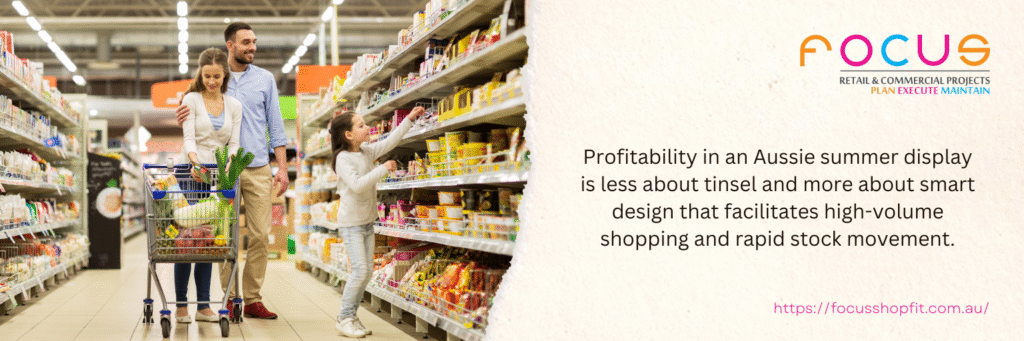
Profitability in an Aussie summer display is less about tinsel and more about smart design that facilitates high-volume shopping and rapid stock movement. Here are the shopfitting secrets that turn your retail space into a Christmas cash register.
- Master the rule of three or profit pyramid
The single most effective visual merchandising strategy for high-volume sales is the rule of three, or pyramid principle, expertly facilitated by a smart modular display system. Instead of lining up products in monotonous rows, profitable displays group products in odd numbers (three, five, seven) and at varying heights, creating a natural focal point that attracts the eye.
Use low, high-end shop display cabinets near the window for feature gifts, stepped risers on gondolas for mid-priced items, and simple floor stacks for high-volume impulse buys. This layering of height and price guides the customer's journey and encourages them to trade up or add on. When Black Friday hits, these flexible systems allow you to swap a high-end gift theme for a "Deal of the Day" stack in minutes.
Tip: Always place your highest-margin item at the peak of your three-tiered display. Use contrasting colours or a small accent light to make it instantly stand out.
- Use high-CRI lighting to make the product sparkle
In the intense Australian summer light, standard store lighting can make products look washed out or dull. Australia's most profitable displays leverage high-quality lighting to enhance product colour and texture, which is critical for gift appeal.
Invest in LED retail track lighting with a high Colour Rendering Index (CRI of 90+). This type of lighting accurately reflects true product colours, preventing that dreaded return trip because the item "looked different in the store."
For summer apparel and homewares, use a cooler white light (around 4000K-5000K) to give the store a fresh, airy feel that counteracts the heat outside. For premium gifts like jewellery or gourmet food, use narrow-beam spotlights to create a dramatic, sparkling effect that highlights exclusivity.
A good shopfitter will ensure your lighting is adjustable and focused entirely on the merchandise, not the floor, maximising the visual draw of your hero products.
- Capitalise on queuing
During the peak retail period, a queue at the checkout is inevitable. Instead of viewing it as a bottleneck, see it as a final, captive sales opportunity. Profitable retailers use their fitout to transform the queue path into a high-converting impulse island.
This requires a dedicated area featuring a modular display system near the POS. These should be small, quick-to-assemble fixtures loaded with low-cost, high-margin, seasonal items: bonbons, novelty socks, small beauty packs, or gourmet treats. Because the customer has already committed to buying, these impulse items act as a simple add-on purchase.
Tip: Stock this area with items below $30. Ensure clear, bold price signage is visible from the line to facilitate quick, no-thought purchases.
- Design for dual seasons: Heat and hype
Unlike the northern winter, Australians shop for two distinct seasons simultaneously: gifts for Christmas and gear for summer holidays. Your shopfitting must accommodate both. Use lightweight, flexible retail fitout elements—like wire baskets or nesting tables—to group related, non-Christmas items (sunscreen, towels, BBQ gear) near seasonal impulse zones. This acknowledges the reality of the Aussie summer and increases basket size beyond traditional Christmas goods. By investing in an agile, high-impact flexible retail fitout, you ensure your store is ready to handle the unique pace, traffic, and climate of Australia's hottest and most profitable retail season.
Ready to transform your summer sales? Take the next step towards a record-breaking summer. Contact Focus Shopfit if you’d like a checklist to audit your retail store.
How flexible fitouts maximise high-volume sales in your Australian store
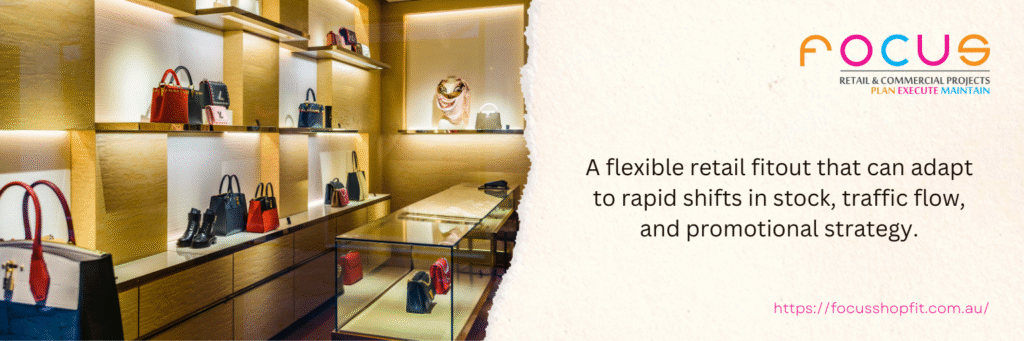
The Australian retail landscape during the November to January period is a high-stakes marathon. The game has changed: it now starts with the pre-Christmas frenzy of Black Friday and Cyber Monday, builds through December gifting, and finishes with the massive Boxing Day clearance. To win this season, your store can't be static. What you need is a flexible retail fitout that can adapt to rapid shifts in stock, traffic flow, and promotional strategy.

A rigid shop layout designed for a quiet Tuesday won't survive the December stampede. The key to maximising high-volume sales lies in agility. Here’s how flexible design elements can turn your store into a sales powerhouse during the peak trading months.
- Embracing modular displays for rapid repositioning
The traditional Christmas shopping timeline has been completely rewritten by global sales events. Retailers must now execute three major campaigns—Black Friday, the main festive season, and Boxing Day—within weeks of each other. This demands displays that can be dismantled, repositioned, and re-merchandised in hours, not days.
Modular retail shelving, like slatwall panels or gondola systems, is your best mate here. These systems allow you to swap out shelves for hanging racks, hooks, or display cubes instantly. For Black Friday, you might need open floor space for large, clearly marked doorbuster displays. By mid-December, those same modular units can be converted into high-density shelving to showcase multiple small gifting items, boosting your Average Transaction Value (ATV).
Tip: During the Boxing Day sales rush, use your modular units to create short, angled aisles near the entrance. This directs customers straight to clearance items, making it easy to spot bargains and get stock off the floor quickly.
- The power of integrated lighting and digital signage
A major sales event like Black Friday requires a sense of urgency, while the mid-season push needs warmth and luxury. Fixed lighting and static signage simply won't cut it.
Invest in retail track lighting that is easily adjustable. You can use sharp, bright spotlights (accent lighting) to highlight specific hero deals during a one-day sale, then soften and widen the beam for general ambient lighting as the focus shifts to experiential shopping closer to Christmas Day.
Digital signage boards are another must-have. A flexible fitout incorporates the wiring and mounting points for temporary digital screens across the store. This allows you to update prices, run countdown timers for sales, and switch promotional content from "Black Friday Bargains" to "Last Minute Gifts" without printing a single poster.
Tip: Position a large digital screen near your main window display. Program it to flash high-contrast promotional messages to grab the attention of passers-by and drive foot traffic inside.
- Designing for traffic flow and checkout efficiency
High-volume sales inevitably mean high traffic, and nothing frustrates an Aussie shopper more than a bottleneck or a massive queue. The entire store layout must be considered a traffic management system.
Your flexible retail fitout should include temporary, high-capacity counters or podiums that can be quickly introduced to expand your checkout capacity during peak hours. Use low, easy-to-move barriers or planters to guide customers through clear pathways, directing them past high-margin impulse displays on their way to the register.
During the pre-Christmas peak, you might use the front-of-store area for product demos and high-value displays. By Boxing Day, this entire zone should be cleared to create a massive, efficient queuing system that allows for rapid transactions and a positive final impression.
Tip: Ensure all shelving units are kept tidy and well-stocked, even during the busiest hours. Flexible, durable shelves that can withstand constant rummaging minimise the visual clutter that can overwhelm and chase away customers.
- Investing in durability and agility
Ultimately, surviving the Australian Christmas retail season comes down to the quality of your shopfittings. Cheap fixtures buckle under the weight of high stock levels and constant customer interaction. Investing in a robust, professional, and flexible retail fitout. This means you have less damage, less downtime, and a consistently professional-looking store, even during chaos. Prioritising adaptability and durability now ensures your space is ready to capture maximum sales throughout high-volume shopping dates.
The Australian summer sales season is too lucrative to leave to chance. A well-planned, flexible retail fitout is your most powerful tool for capitalising on every single moment, from the impulse buys of Black Friday to the efficient clearance of Boxing Day. Upgrade your modular retail shelving and adjust your retail track lighting now to ensure your store is ready for the biggest sales period of the year. Contact Focus Shopfit to incorporate the latest trends for retail fitout.
5 shopfitting must-haves for a hot Christmas retail season
The Australian Christmas retail calendar is a unique beast. While it could be snowy windows and hot chocolate, it’s also for Black Friday sales in November, sweltering weather, and a peak shopping period defined by experiences, not transactions.

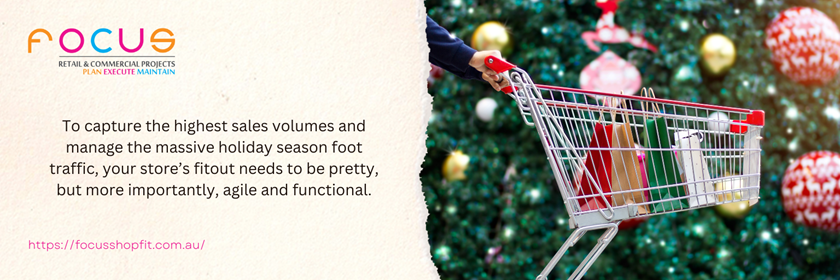
To capture the highest sales volumes and manage the massive foot traffic from November through January, your store’s fitout needs to be pretty, but more importantly, agile and functional.
Here are five essential shopfitting elements every Australian retailer must nail to thrive during the summer rush.
- The modular impulse zone
With the rise of Black Friday and Cyber Monday, shoppers are primed for purchases early, and they move fast. Once a customer has found their main gifts, you need a high-impact, temporary space near the checkout or a key traffic bottleneck to encourage those last-minute, high-margin impulse buys.
The secret here is modular retail shelving. Unlike fixed fixtures, a modular system can be wheeled in, reconfigured with different tiers, and swapped out with ease.
Tip: Focus on the 'Rule of Three.' Group three related, low-cost items (e.g., a novelty candle, a reusable coffee cup, and a gourmet chocolate bar) on a small, freestanding display unit. Use bright, high-CRI (Colour Rendering Index) accent lighting to make the products visually pop.
- Cool, crisp LED lighting design
In the Australian summer, a store that is too warm, both physically and visually, can put customers off. Your lighting design needs to counteract the heat and the sensory overload of the season. Ditch the warm, low-level atmospheric lighting for high-energy, crisp illumination that highlights product quality.
A shopfitter can install cool white LED lighting (around 4000K-5000K) over key product displays. This temperature is proven to make products, especially electronics, fashion, and beauty items, look cleaner, brighter, and more enticing. More importantly, adjustable retail track lighting allows you to instantly change your focus from wall displays to floor gondolas as stock levels fluctuate throughout the holiday period.
Tip: Check your fitting room lighting. Use frontal, diffused lighting with a high CRI (90+) to ensure customers look and feel their best when trying on summer apparel, significantly reducing the likelihood of post-Christmas returns.
- Dedicated queuing and returns systems
Nothing kills the shopping experience faster than a 30-minute queue, especially when the mercury is rising outside. A professional shopfitter understands that the Point of Sale (POS) area is critical, particularly during the rush.
You need a counter and a system. This involves installing temporary, secure stanchions or woven rope barriers to guide customer flow efficiently. Establish a separate, clearly marked 'Service/Returns' counter. January is the peak month for returns, and a designated, comfortable area turns a potentially negative experience into a positive brand touchpoint, encouraging future loyalty.
Tip: Use the queueing space for low-ticket items and gift card displays. This leverages the customer’s captive time before checkout for final impulse conversions.
- Coastal-inspired visual storytelling
Forget the snow globes and thick wool scarves. Your visual merchandising must resonate with the Australian holidays reality: beaches, barbecues, and outdoor living. Your shopfitter should focus on materials and palettes that feel naturally 'cool' and authentic to our summer lifestyle.
Think raw, whitewashed timber, woven textures like raffia or bamboo, and a colour palette of crisp white, sandy beige, and ocean blues. This gives the store a unique look and provides a welcome visual oasis from the urban heat. The fitout should tell a story of a relaxed, fun Aussie Christmas.
- Durable, high-capacity shelving
The volume of products and the frantic nature of restocking during the Christmas peak can quickly overwhelm flimsy fixtures, leading to untidy aisles and product damage.
Invest in heavy-duty, commercial-grade shelving for high-volume categories (like toys, books, and liquor). Sturdy steel or robust melamine shelving ensures the store looks neat and organised, even when stock is flying off the shelves. This durability is vital for long-term operational efficiency.
By focusing on these five fitout must-haves, Australian retailers can ensure their physical space is optimised not just for aesthetic appeal, but for the intense commercial pressure and unique climate of the Aussie summer sales season.
Contact Focus Shopfit to get expert tips on visual merchandising, using light, and durable fixtures to protect your stock and boost impulse purchases from Black Friday through Boxing Day. Future-proof your space and make your Australian store the top destination for Christmas shopping.
Designing service counters that drive impulse add-ons
The service counter, or “cash wrap,” is arguably the most valuable square metre in any Australian retail store. It's the point where customer commitment is highest, making it the final and most crucial opportunity for an impulse sale. However, many retail fitouts treat the counter as purely functional—a place to process payment—failing to realise its immense potential as an Add-On Command Centre.
For Australian businesses to stop leakage (the loss of potential extra revenue) and significantly increase their Average Transaction Value (ATV), the counter must be meticulously designed. This requires a professional shopfitting strategy focused on product placement, lighting, and seamless technology integration.
- The science of the impulse curve
Impulse buying is a predictable behaviour triggered by proximity and time. As customers queue or wait for their transaction to finalise, their mental guard is down, creating the perfect window for a small, desirable purchase.
Your fitout must facilitate this curve:
- The queue funnel: Design the queue path using low-level fixtures or temporary rope barriers that guide customers directly past high-margin, low-cost impulse items. The items should be visible and easily accessible without the customer having to break stride.
- Eye-level displays: The space directly on the countertop (the “hot zone”) should be reserved for items that require zero decision-making time. Think novelty gifts, high-quality confectionery, or travel-sized versions of best-sellers. These items must be clearly priced and perfectly presented.
- The counter's front: If your counter has a front face visible to customers while they wait, this vertical space is ideal for shallow, visually engaging displays or digital screens showcasing short videos of new accessories.
Tip: Rotate impulse stock weekly. Customers who see the same items repeatedly stop noticing them. Frequent changes drive novelty, prompting them to look and buy.
- Integrated joinery for maximum visibility
A clunky, cluttered counter deters sales. The most profitable service counters use custom joinery to integrate displays seamlessly, maximising usable space while maintaining an organised, premium look.
- Recessed display cases. Build shallow, lockable glass display cases directly into the countertop or front face. This is ideal for high-value impulse items like jewellery, premium accessories, or gift cards. Recessing the display protects the product while keeping the main counter surface clear for transactions, improving staff workflow.
- Under-counter lighting. Use focused LED accent lights within display wells. Good lighting draws the eye, makes packaging pop, and creates the illusion of higher value. A professional shopfitting approach ensures these lights are cool-toned to avoid glare and heat build-up.
- Integrated technology pockets: Ensure all technology (POS terminals, EFTPOS machines) is recessed or positioned ergonomically. This clears the counter for product displays and improves the checkout speed, enhancing customer experience.
- Service with a display focus
The counter must be designed to support the sales team's final push. The physical layout should prompt staff interaction and make 'add-on' recommendations simple and natural.
- Complementary product shelving. On the staff side of the counter, install small shelving units that are easy for staff to access but visible to the customer. This can house "forgotten items" like batteries, small warranty packages, or protective sprays. When a staff member asks, "Do you need batteries for that?" the product is literally within arm's reach.
- Gift wrapping stations. Especially during the Australian summer holiday season, a small, clean, integrated gift-wrap station signals premium service. This can be built into an extension of the main counter and easily attracts an additional small fee or purchase.
By viewing the service counter not as an endpoint, but as a final, high-value merchandising destination, Australian retailers can significantly enhance the profitability of their retail fitout. This strategic shopfitting ensures that no sales potential is left behind.

Your service counter is your last chance to impress and sell. Stop the revenue leakage by transforming this space from a simple checkout into a high-powered impulse centre. By using smart joinery and strategic placement, you can dramatically increase your Average Transaction Value and elevate the final moment of the customer experience.
Contact Focus Shopfit today for a consultation on how custom shopfitting design can transform your existing service counter into an impulse sales powerhouse!
Using acoustic design to enhance the retail experience
In the bustling world of Australian retail, we often focus on what customers see — the colours, the displays, the lighting. But what about what they hear? An overlooked element of retail design, acoustics plays a surprisingly powerful role in shaping the customer experience, influencing their mood, comfort, and ultimately, their likelihood to purchase. Managing sound is no longer an afterthought but a strategic element.
A poorly designed acoustic environment can feel chaotic and overwhelming, while a well-considered one creates a sense of calm, privacy, and sophistication. This is where professional shopfitting expertise like Focus Shopfit truly shines, turning noise into a sales asset.
- Identifying common noise factors
Before any acoustic solutions can be implemented, a shopfitting expert will identify the primary sources of unwanted noise in a retail space:
- Hard surfaces. Concrete floors, glass shopfronts, and exposed ceilings (common in modern industrial-chic designs) are notorious for reflecting sound, creating excessive reverberation and echo.
- Internal noise. Staff chatter, music that’s too loud, the clatter of a cafe, or even the general hubbub of many customers can create an overwhelming din.
- HVAC systems. Noisy air conditioning units or ventilation systems can generate a constant, irritating background hum.
Ignoring these issues can lead to customer fatigue, difficulty hearing staff, and a perception that the store is cheap or poorly managed, directly impacting customer dwell time.
- Strategic material selection
The core of effective acoustic design in a retail fitout lies in strategic material selection. It’s about introducing elements that absorb sound rather than reflect it.
- Acoustic panels: Modern acoustic panels come in a vast array of colours, textures, and even customisable prints, allowing them to blend seamlessly with any retail design aesthetic. They can be installed on walls, ceilings, or even suspended as decorative baffles, effectively soaking up excess sound waves.
- Soft furnishings and fabrics: In areas designed for relaxation or consultation, incorporate upholstered seating, heavy curtains, or textile wall hangings. These materials naturally dampen sound. For changing rooms, ensure thick carpeting and fabric-lined walls to provide privacy and comfort.
- Perforated materials: Consider perforated timber panels or metal screens for feature walls or shelving backings. The perforations allow sound waves to pass through and be absorbed by a backing material, reducing echo without compromising on a sleek, modern look.
Tip: For high-ceilinged, open-plan stores, focus on ceiling-mounted acoustic solutions. Suspended baffles or clouds can be highly effective without encroaching on valuable wall space.
- Crafting diverse experiences with sound
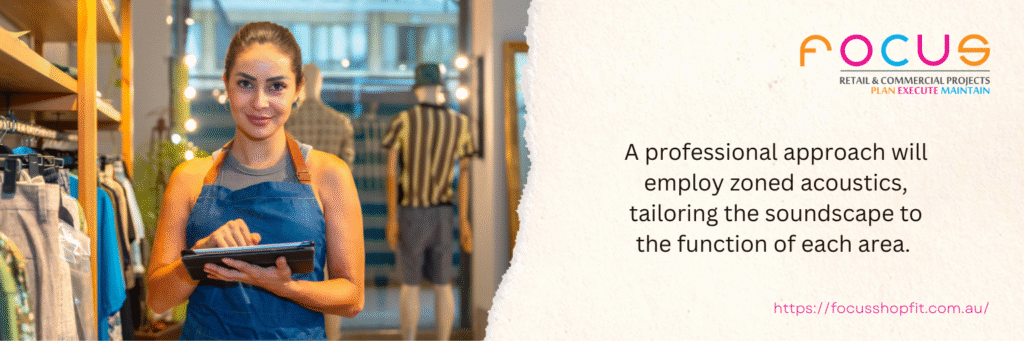
Not all areas of a retail store require the same acoustic treatment. A professional approach will employ zoned acoustics, tailoring the soundscape to the function of each area.
- High-energy zones. Near the entrance or promotional areas, a slightly livelier acoustic can be acceptable, even desirable, to convey excitement. Here, hard surfaces might be used judiciously.
- Quiet consultation areas. In jewellery stores, banks, or high-end boutiques where sensitive conversations occur, maximum sound absorption and even sound masking (playing low-level, unobtrusive background noise) are crucial to ensure privacy and focus.
- Hospitality zones: If your retail store includes a café, robust acoustic planning is paramount. Separate the noise source with partial walls, screens, and dense acoustic panelling to prevent the clatter of coffee machines and chatter from overwhelming the main shopping area, enhancing customer dwell time throughout the store.
By consciously managing sound, Australian retailers can transform their space from a noisy environment into a comfortable, inviting, and ultimately more profitable experience.
In the competitive Australian retail market, the subtle power of sound can make or break a customer's visit. By investing in strategic acoustic retail design through expert shopfitting, you create an environment that encourages comfort, privacy, and extended customer dwell time—all key ingredients for sustained success. Don't let unwanted noise undermine your brand; make sound a part of your success story.
Ready to fine-tune your store's soundscape? Contact Focus Shopfit today for a consultation on how acoustic shopfitting solutions can enhance your Australian retail space and boost customer sales!
Beyond aesthetics: Shopfitting for staff workflow and reducing injury risk
In the Australian retail environment, a store’s layout is often judged by its curb appeal. But true success hinges on something far less visible: the efficiency and safety of the staff working behind the scenes. Professional shopfitting is the key to creating a space that not only looks fantastic but also functions as a safe, ergonomic, and high-performing workplace.
Ignoring staff workflow and safety in the retail fitout phase is a costly mistake. It leads to slower service, higher rates of absences due to injury, and ultimately, a poorer customer experience. Australian business owners have a legal obligation under Work Health and Safety (WHS) laws to minimise risk and a smart fitout makes meeting this requirement simple and profitable.
- Ergonomic design at the point of sale (POS)
The checkout counter is a high-traffic, repetitive task zone where staff spend hours on their feet. If the design is flawed, repetitive strain injuries (RSIs) are inevitable.
A professional shopfitting team focuses on ergonomics:
- Optimal counter heights. Counters should be designed to reduce excessive reaching, bending, or twisting, accommodating a variety of staff heights. Adjustable height counters are an excellent investment, though fixed counters must be planned carefully with suitable anti-fatigue mats.
- Integrated technology. POS screens, scanners, and EFTPOS terminals should be recessed or angled to prevent glare and placed within the staff's neutral reach zone. This minimises shoulder strain and repetitive movement.
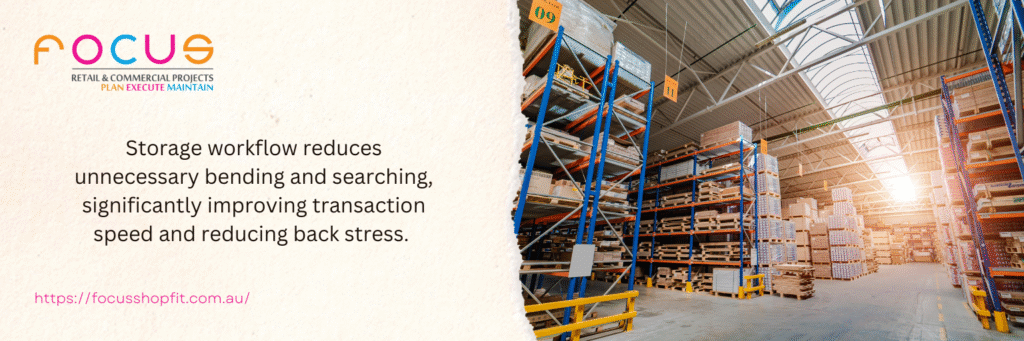
- Storage workflow. All frequently used items—bags, receipt paper, and security tags—must be stored directly under the counter in easily accessible, lightweight drawers. This reduces unnecessary bending and searching, significantly improving transaction speed and reducing back stress.
Tip: During the design phase, simulate a typical transaction motion with your shopfitting team to ensure every item and piece of equipment is placed for maximum flow and minimum strain.
- Streamlining back-of-house and stock movement
The stockroom is where many serious retail injuries occur—trips, falls, and muscle strains from lifting. A well-designed back-of-house area is essential for reducing risk and improving staff workflow.
- Clear pathways and lighting. Stockroom aisles must be wide, clear, and brightly lit to prevent trip hazards. Storage systems should be clearly labelled, promoting efficiency and preventing staff from needing to climb over items.
- Vertical storage solutions. Utilise durable, adjustable vertical shelving that is designed for commercial loads. Heavy items must be stored at waist height or below to comply with safe manual handling practices. Install safe, sturdy ladders or step stools in logical places for accessing higher stock, rather than relying on unstable chairs.
- Dedicated receiving area. The space where deliveries are unpacked must be separate from the main stock storage. This ensures boxes and pallets aren't blocking fire exits or emergency paths, a crucial WHS compliance measure.
- Change room and display safety
Even customer-facing areas can pose staff risks if not planned correctly. Change rooms require durable, secure retail fitout components that withstand heavy use and minimise maintenance issues that could harm staff.
- Secure fixtures. Mirrors, hooks, and benches in change rooms must be securely mounted to Australian standards. A mirror or bench that becomes loose poses an immediate safety hazard.
- Safe display access. For high displays or tall shelving, ensure safe and integrated access solutions are planned. This might involve custom-built rolling ladders that lock into place or specific areas designed to accommodate scissor lifts safely during setup. Never rely on staff using unsecured chairs or boxes to merchandise.
By prioritizing safety and staff workflow from the outset, the retail fitout becomes a long-term asset. It protects your team, keeps your business compliant with WHS laws, and ultimately allows your staff to focus on delivering the excellent service that drives sales.
True quality in Australian retail design is measured not just by the customer's visual impression, but by the health and efficiency of the team running the store. Investing in ergonomic counters, clear stock movement paths, and safe display access through professional shopfitting is the smartest way to reduce injury risk and ensure seamless staff workflow for years to come. Contact Focus Shopfit today for a WHS-focused design audit and consultation to improve the ergonomics of your current retail fitout.