
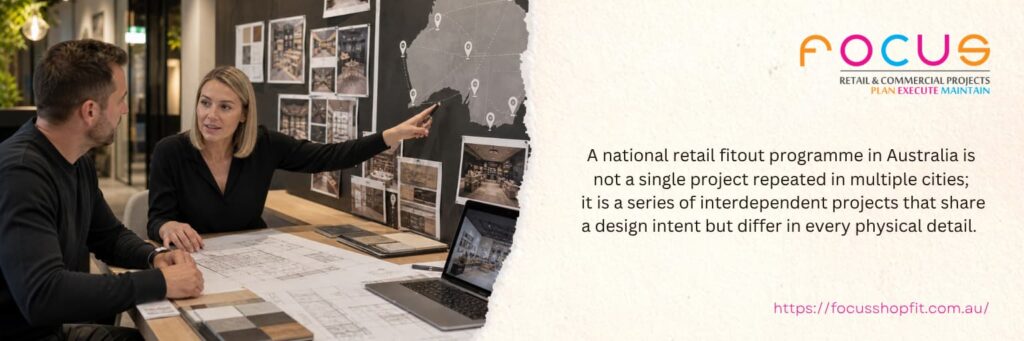
A national retail fitout programme in Australia is not a single project repeated in multiple cities; it is a series of interdependent projects that share a design intent but differ in every physical detail.
For most of the last decade, the standard briefing process for a national retail fitout in Australia looked something like this: head office issues a brand standards document, a fitout manual, and a target cost per square metre. The retailer’s property team sends it to a list of shopfitters in each state. Each state contractor prices against the same brief, and the cheapest credible number wins.
That model is breaking down. The reasons are practical, not philosophical, and understanding what has changed tells you a great deal about how to run a national retail fitout programme in 2026.
What has shifted in the briefing process
These are the four changes retailers running national programmes are describing most consistently:
- Fitout manuals are arriving out of date. Brand standards developed in one fitout cycle often do not account for material availability, lead time changes, or building condition variations that have emerged by the time the next rollout starts. A manual written for a 2023 programme can create procurement problems in 2026.
- The single point of contact model is replacing the state-by-state tender. Retailers with more than five stores in a rollout are increasingly preferring one contractor who can manage programme-level sequencing rather than five separate contractors who each manage their own corner.
- Approvals and council timelines are being briefed in advance, not discovered during delivery. Property teams are now front-loading approval research into the brief rather than leaving it to the contractor, which reduces programme delays caused by unexpected development application (DA) requirements in specific councils.
- Contingency is being built in at the programme level, not the individual store level. Rather than each store carrying its own 10% contingency, programme-level budgets are pooled, which reduces overall cost while maintaining financial cover.
The multi-site reality
A national retail fitout programme in Australia is not a single project repeated in multiple cities; it is a series of interdependent projects that share a design intent but differ in every physical detail. The Westfield in Bondi Junction is not the same building as the Westfield in Doncaster. The base build condition in a Brisbane shopping centre is different to the base build condition in Perth. Landlord fitout requirements differ between REITs, and even between different centres managed by the same REIT.
This means the shopfitter managing a shopfitting national rollout Australia programme needs to be working with a brief that is specific enough to produce consistent brand outcomes but flexible enough to accommodate site-by-site variation. Rigid fitout manuals that do not account for this variation create constant change order cycles, which is where programme costs blow out.
The contractors best placed to manage the retail fitout design process at a national level are those who have built the coordination infrastructure to manage multiple simultaneous sites, including consistent procurement, standardised documentation, and a project management system that gives the retailer visibility across all stores in progress at once.
What a good national brief looks like in 2026
The retailers getting the best outcomes from their multi-site retail fitout programmes are briefing differently to the old model. A well-structured national brief now typically includes:
- A design intent document, not just a finishes schedule. The intent behind each design decision, not just the specification, allows the contractor to make informed substitutions when a specified product is unavailable without compromising the brand outcome.
- A tiered specification. Core elements that are non-negotiable for brand consistency are separated from elements where local variation is acceptable. This reduces the number of approval cycles per store significantly.
- A programme framework, not just individual store programmes. The national programme calendar shows when each store is expected to start, what its approval pathway is, and what the dependency relationships are between stores.
- A named contact with authority. National programme projects slow down when approvals require escalation to someone who is not in the brief. Nominating the decision-maker for design variations at the brief stage removes weeks from the programme.
- A clear position on landlord-preferred contractors. Some shopping centre landlords require tenants to use approved contractors or to notify preferred subcontractors. This needs to be addressed in the brief, not discovered during tendering.
The cost of the old briefing model
The state-by-state tender model produces the lowest individual store price at the time of appointment. It rarely produces the lowest programme cost at the time of completion. The reasons are straightforward. Five separate contractors managing five stores in five cities means five separate procurement processes, five separate quality management approaches, and five separate escalation chains when a problem arises.
Programme-level issues, such as a materials shortfall, a landlord requirement that affects all stores, or a design change requested by head office mid-programme, are significantly cheaper to manage through a single contractor who can implement the change across all sites simultaneously than through five contractors who each need to price and approve the change independently.
For context on the total cost of a retail fitout at different specification levels, the gap between programme-managed and individually-managed costs tends to widen with each additional store above five.
What to look for in a national fitout partner
The distinction between a contractor who can build individual stores and a contractor who can manage a national retail fitout programme comes down to infrastructure rather than capability at the individual site level. The right questions to ask are:
- Do they have a dedicated programme manager, or is each site managed by a site supervisor with no programme-level oversight?
- How do they manage procurement across multiple simultaneous sites, and what is their approach when a specified material is unavailable in one state?
- How do they report to the client at a programme level? Is there a single dashboard, or do you receive five separate site reports?
- Have they delivered programmes of similar scale, and can they provide references from the head office team, not just the individual store’s property contact?
These questions separate a shopfitter who is good at building stores from one who is equipped to manage a national retail fitout Australia programme at scale.
Focus Shopfit has been managing national retail fitout programmes from its Perth and Auburn offices since 1984. If you are planning a rollout and want to understand how programme-level management would work for your brief, start a conversation about your project and we can walk through the structure that fits your programme.