Melbourne is Australia’s most demanding fitout market. The regulatory complexity is higher than any other Australian city. Design expectations are more sophisticated, and trade costs reflect a construction market simultaneously running major infrastructure projects alongside a busy commercial fitout pipeline.
Operators who commit to a Melbourne site without understanding the approvals environment, the Heritage Victoria requirements, or the trade lead time realities routinely find themselves behind programme before construction has started. What follows covers each phase of the process for 2026 projects.
Phase 1: The Melbourne market in 2026
Melbourne’s commercial fitout market in 2026 is characterised by strong activity in inner-city and inner-suburban precincts, moderate recovery in the central business district (CBD), and sustained demand across food and beverage in neighbourhoods, including Fitzroy, Collingwood, Richmond, South Yarra, and Brunswick. The hospitality sector, which contracted sharply through the early 2020s, has stabilised, and new operators are entering the market with measured confidence.
For retail shopfitters Melbourne, fashion, wellness, and specialty food retail are generating the most active fitout enquiry. Medical and allied health fitouts are growing, particularly in suburban strip retail environments and mixed-use developments in the outer south-east and north-west corridors. Office fitout activity is consolidating around smaller, higher-quality tenancies in the inner suburbs as occupiers prioritise quality per square metre over raw floor area.
Design expectations in Melbourne are genuinely distinct from other Australian markets. Standard commercial finishes that would be acceptable elsewhere can look under-specified here, and operators should price for Melbourne’s design expectations, not a national average. How open-plan and zoned layouts perform differently in high-footfall Australian retail environments is directly relevant context for Melbourne operators designing new tenancies.
Phase 2: Council approvals and Heritage Victoria
Shopfitting in Melbourne means working in one of Australia’s most complex approval environments, where heritage overlays, planning scheme amendments, and council-by-council DA variations require a contractor who understands the local landscape before the first drawing is produced.
Victoria’s planning system, administered under the Planning and Environment Act 1987, requires planning permits for many categories of commercial fitout work that would not trigger approvals in other states. The permit requirement depends on the local council’s planning scheme, the zone the property sits in, and whether any overlays apply. The Heritage Overlay is the most significant for fitout purposes, applying to thousands of properties across the Melbourne metro area and requiring both Heritage Victoria assessment and council planning permit approval for works affecting heritage fabric.
For inner-city councils in 2026:
- City of Melbourne: active development application (DA) process for change of use and external works in central Melbourne; shopping centre tenancies generally follow centre guidelines without a separate council permit for interior-only works
- Yarra, Port Phillip, and Stonnington: high concentration of Heritage Overlay properties in inner precincts, requiring Heritage Victoria consultation for works affecting external fabric or heritage-significant interiors
- Monash, Knox, and Whitehorse: more standard approval pathways for commercial fitouts in outer suburbs, with heritage overlays applying in selected precincts only
Heritage Victoria’s requirements are specific. Works to heritage-listed premises must be accompanied by a heritage impact statement prepared by a qualified heritage practitioner. Build four to eight weeks of heritage assessment time into any programme for a Heritage Overlay site.
The Australian Building Codes Board (ABCB) publishes the national building approval framework within which Victorian regulations sit, useful background for anyone navigating this process for the first time. How Melbourne’s council approval process compares to Sydney’s, and where the key differences lie, is covered in a detailed comparison of both cities’ DA and CDC pathways.
Phase 3: Design trends shaping shopfitting in Melbourne this 2026
Material authenticity is the dominant direction. Timber, stone, raw concrete, and handmade ceramics feature at a frequency that reflects consumer appetite for spaces that feel made rather than manufactured. The counterpoint is construction efficiency: authentic materials take time and skill to install correctly, and custom joinery lead times in Melbourne’s current market run 10 to 16 weeks for complex work.
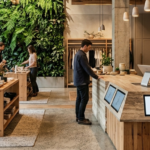
Biophilic design continues to be specified across retail, hospitality, and office fitouts. Living walls, natural materials, and maximised natural light are consistently associated with improved customer dwell time and staff productivity under the WELL Building Standard research framework, which is increasingly cited by Melbourne landlords and tenants as a performance benchmark.
Sustainability credentials have moved from optional to expected for operators above the basic category. Low-VOC finishes, energy-efficient lighting, and fitout designs that minimise waste are now standard expectations. Seamless technology integration alongside sustainable materials is also a growing requirement, and how digital displays and tech can be built into a retail fitout without compromising the design intent is directly relevant for Melbourne operators.
Phase 4: Managing trade costs in Melbourne
Melbourne’s construction labour market is one of the tightest in Australia. Major infrastructure projects continue to absorb significant electrical, plumbing, and HVAC capacity that would otherwise be available to the commercial fitout sector. Programme certainty requires early subcontractor engagement. A shopfitter who tenders broadly and assembles a team from whoever is available at the time will face delays at every trade stage. Selecting a shopfitter with established Melbourne subcontractor relationships is one of the most important decisions in the procurement process.
Custom joinery lead times also warrant specific attention. Melbourne workshops are currently quoting 10 to 16 weeks for complex custom work. Specifying joinery during the design development phase, not at construction documentation, is the most effective way to prevent joinery delays from extending the overall programme.
Phase 5: Budgeting a Melbourne fitout in 2026
Melbourne fitout costs in 2026 reflect a market where material costs have stabilised from their 2022 to 2023 peak but trade labour remains at a premium. Indicative ranges per square metre:
- Standard retail fitout (mid-specification, 80 to 150 square metres): $2,200 to $3,500
- Premium retail or hospitality fitout (custom joinery, feature finishes, 80 to 200 square metres): $3,500 to $5,500
- Healthcare or medical fitout (clinical compliance, specialist services): $3,000 to $5,000
- Office fitout (activity-based, mid-specification, 200 to 500 square metres): $1,800 to $3,000
These figures are all-inclusive of builder’s preliminaries, trade subcontractors, and fitout-specific works. They exclude loose furniture, FF&E, signage, IT infrastructure, council fees, and heritage assessment costs. National pricing benchmarks across fitout categories show Melbourne generally sitting in the upper quartile of Australian capital city pricing.
The return on a well-specified fitout compounds across the full trading period. A detailed analysis of what a professionally delivered fitout is worth over a tenancy is worth reviewing before specification decisions are made, particularly in a market like Melbourne where the quality bar is high.
Focus Shopfit has been delivering commercial fitouts across Victoria since 1984. To talk through your shopfitting project with a team that understands Heritage Victoria requirements, council approval timelines, and trade market conditions, reach out here and we will map out what your project involves before any commitments are made.